
In this lesson you will learn to
- Explain financial, impact and double materiality
- Apply each to a business
- Describe how a materiality assessment is documented
Materiality is how a company decides which ESG subjects matter enough to report. There are two ways to look at it, and the frameworks differ on which they use.
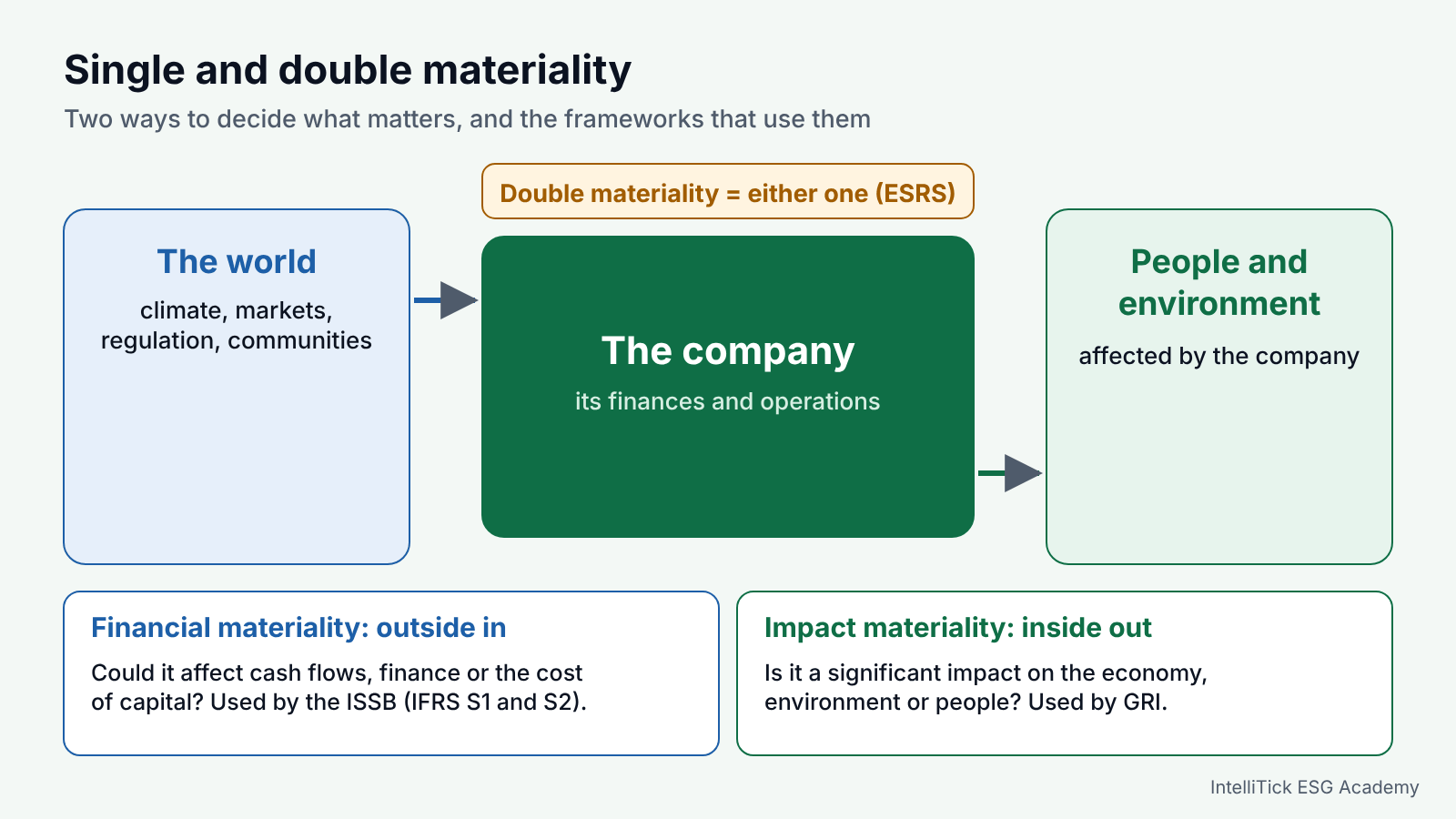
- Financial materiality (outside in): a subject is material if it could reasonably be expected to affect the company's cash flows, access to finance or cost of capital. The ISSB standards, IFRS S1 and S2, use this lens3.
- Impact materiality (inside out): a subject is material if it represents the company's most significant impacts on the economy, the environment and people. The GRI Standards use this lens6.
- Double materiality uses both: a subject is material if it is material from either perspective. The EU's ESRS require it.
A water-intensive plant in a dry region shows the difference. Its water use is an impact on the local community and environment, and it is also a financial risk if the plant has to cut production in a drought. Under double materiality, both reasons count.
Materiality is a decision a company has to document: which subjects it considered, how it assessed them, who approved the result, and why each subject is in or out. That record is what an assurer, an investor or a regulator asks to see.
Practice
Which lens finds it material?
For a software services company with 40,000 employees and offices in Bengaluru and Pune, decide whether each topic is likely material under financial materiality, impact materiality, or both: (1) employee attrition and skills; (2) electricity use in offices and data centres; (3) data privacy; (4) water use; (5) diversity and inclusion.
Show the model answer
- Both — talent drives revenue and costs (financial); careers and wellbeing of 40,000 people (impact).
- Impact and moderately financial — emissions from electricity (impact); energy cost and customer emissions questions (financial).
- Both — breaches harm customers (impact) and bring penalties and lost contracts (financial).
- Likely impact only, and modest — offices use water, sometimes in stressed cities; rarely a financial driver for software. It may still be material on impact in a water-stressed city.
- Both — impact on people, and financial through talent and client requirements.
The point: the same topic can be in or out depending on the lens, so state which lens you apply.
Check your understanding
Choose an answer to see if you are right.
Sources for this lesson
- IFRS S1 General Requirements for Disclosure of Sustainability-related Financial Information — IFRS Foundation. June 2023; checked November 2026
- GRI 3: Material Topics 2021 — Global Reporting Initiative. 2021; checked November 2026
Completing every lesson opens the exam and the certificate. Sign in with your e-mail to record your progress — no password and no account.
More: ESG practice questions · notes (PDF) · ESG glossary