
Free CSRD and ESRS notes
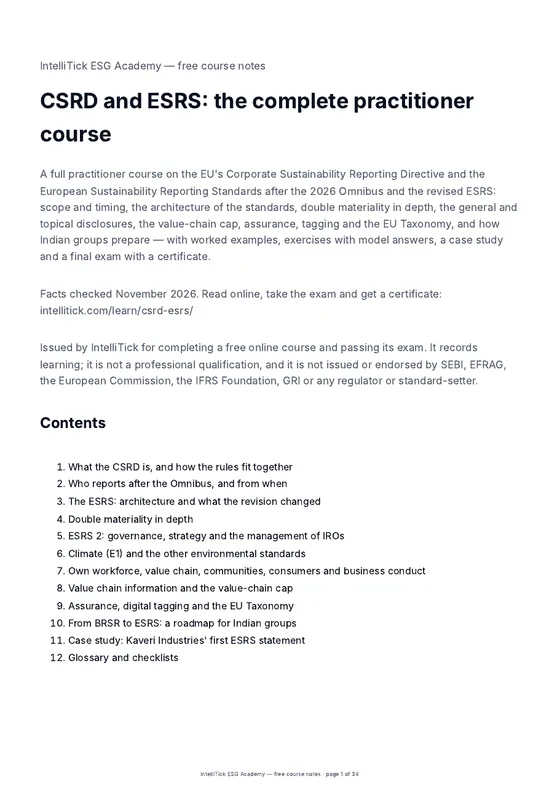
Every lesson of CSRD and ESRS: the complete practitioner course in one PDF — diagrams, worked examples, exercises with model answers and sources. Free, no sign-in.
Illustrative image
What the notes cover
Module 1 — The law
- What the CSRD is, and how the rules fit togetherExplain what the CSRD requires and where the sustainability statement sits; Describe the legal pieces — the directive, national laws, the ESRS delegated acts and the 2025–26 Omnibus changes; Explain why national transposition matters, with Germany as the example; State the assurance requirement.
- Who reports after the Omnibus, and from whenApply the thresholds to EU companies and groups; Apply the rules for non-EU groups, including Indian groups with EU subsidiaries and branches; Work out the first reporting year; Explain the transitional options for companies that already reported.
Module 2 — The standards
- The ESRS: architecture and what the revision changedDescribe the cross-cutting and topical standards; Explain what the 2026 revision changed — datapoints, materiality, fair presentation, reliefs; Work out which ESRS set applies to a given financial year; Explain how datapoints, phase-ins and omissions work.
- Double materiality in depthIdentify impacts, risks and opportunities across the value chain; Score impact materiality by severity and likelihood, and financial materiality by magnitude and likelihood; Use the top-down approach where it fits, and a detailed assessment where it does not; Set thresholds and document the assessment so that it survives assurance.
- ESRS 2: governance, strategy and the management of IROsDescribe what ESRS 2 requires on governance, strategy and the management of impacts, risks and opportunities; Present policies, actions, targets and metrics for a material topic; Link sustainability information to the financial statements; Avoid boilerplate that adds length but no information.
Module 3 — The topical standards
- Climate (E1) and the other environmental standardsExplain what E1 asks on transition plans, targets, energy and greenhouse gases; Prepare the GHG figures E1 needs from a GHG Protocol inventory; Explain what E2 to E5 cover and when they apply; Identify the data an Indian operation will be asked for.
- Own workforce, value chain, communities, consumers and business conductExplain what S1 to S4 and G1 cover; Prepare the main own-workforce metrics; Link human rights due diligence to S2 and S3; Prepare the business conduct disclosures.
Module 4 — Doing the work
- Value chain information and the value-chain capExplain the value-chain cap and the voluntary standard; Design supplier requests that respect the cap and still produce usable data; Use estimates and averages where suppliers cannot provide data; Advise an Indian supplier on how to respond to EU customers.
- Assurance, digital tagging and the EU TaxonomyPrepare for limited assurance of the sustainability statement; Explain digital tagging of the statement; Explain how the statement is filed and enforced, and who sets the penalties; Explain the EU Taxonomy disclosure and its three KPIs; Plan the controls that make all three work.
- From BRSR to ESRS: a roadmap for Indian groupsMap BRSR indicators to the ESRS topics; Identify the gaps an Indian group must close for ESRS reporting; Plan a first CSRD year as a project; Decide what to centralise and what to collect locally.
Module 5 — Capstone
- Case study: Kaveri Industries' first ESRS statementApply scope, timing, materiality and disclosure rules to one group; Score and decide material topics; Plan the data and the assurance for the first year.
Reference
- Glossary and checklistsUse the vocabulary of CSRD reporting precisely; Keep a checklist for each stage of the first year.
Test yourself with the CSRD and ESRS practice questions, then take the exam for a free certificate you can add to LinkedIn.
Start the courseFacts checked November 2026. Rules change: check the cited source before relying on a date or threshold. Issued by Intellitick for completing a free online course and passing its exam. It records learning; it is not a professional qualification, and it is not issued or endorsed by SEBI, EFRAG, the European Commission, the IFRS Foundation, GRI or any regulator or standard-setter.