
ESG fundamentals: the complete foundation course
What ESG is, who asks for it, how the frameworks and laws fit together, and how to start working in it — with Indian examples.
- Lessons
- 12
- Study time
- 3 hours 10 minutes
- Exercises
- 13

Free course with certificate
Report under the CSRD and the revised ESRS after the Omnibus: who is in scope, double materiality, the standards, assurance and enforcement.
Illustrative image
A full practitioner course on the EU's Corporate Sustainability Reporting Directive and the European Sustainability Reporting Standards after the 2026 Omnibus and the revised ESRS: scope and timing, the architecture of the standards, double materiality in depth, the general and topical disclosures, the value-chain cap, assurance, tagging and the EU Taxonomy, and how Indian groups prepare — with worked examples, exercises with model answers, a case study and a final exam with a certificate.
The Corporate Sustainability Reporting Directive (CSRD) is the EU law that requires the largest companies to publish a sustainability statement in their management report, prepared under the European Sustainability Repo…
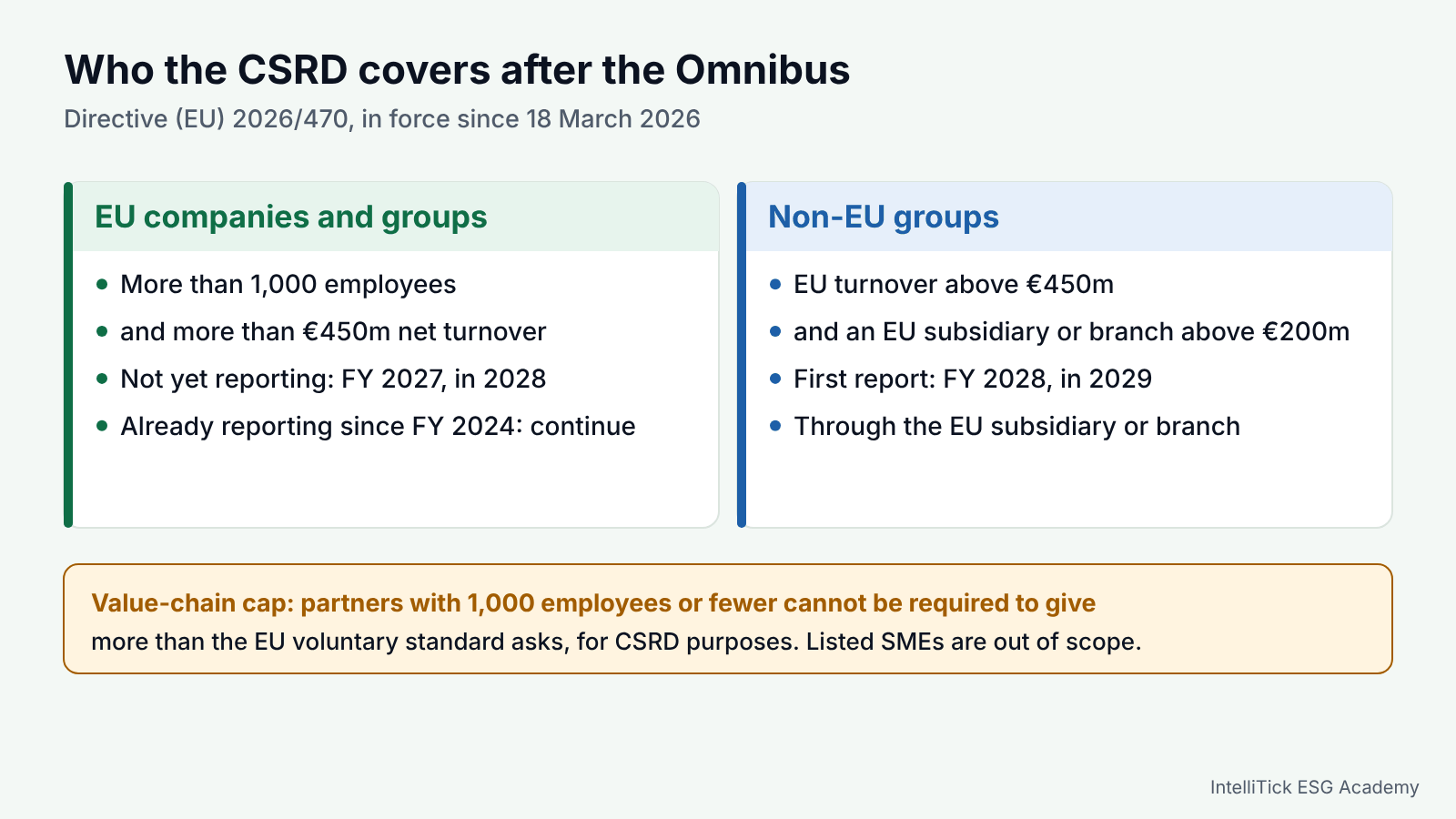
Since the Omnibus directive entered into force on 18 March 2026, the CSRD applies to EU companies and groups with more than 1,000 employees and more than €450 million in net turnover, and to large non-EU groups13.
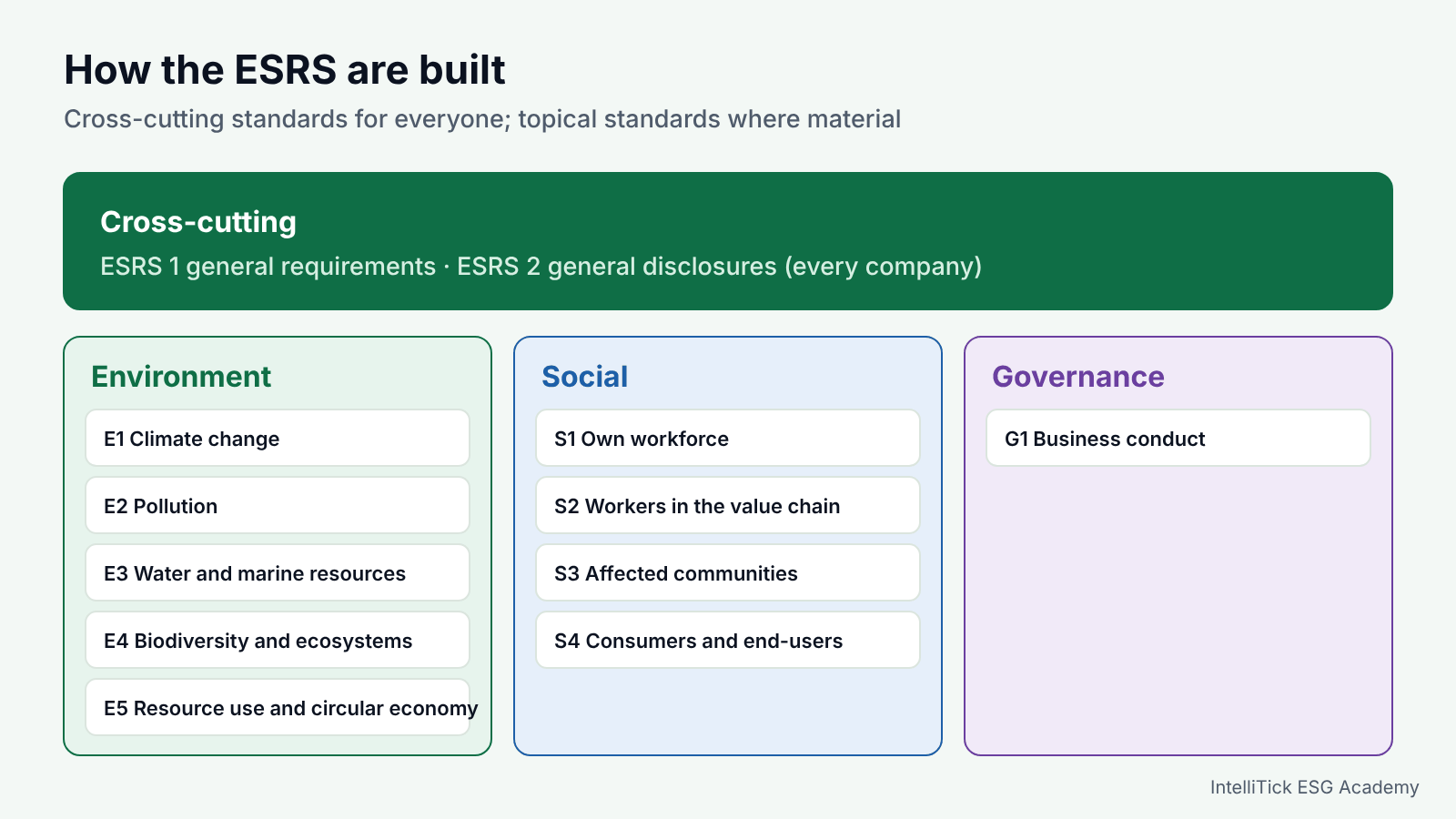
The ESRS are a set of standards: two cross-cutting ones that apply to everyone, and topical ones that a company reports on when its materiality assessment finds the topic material.
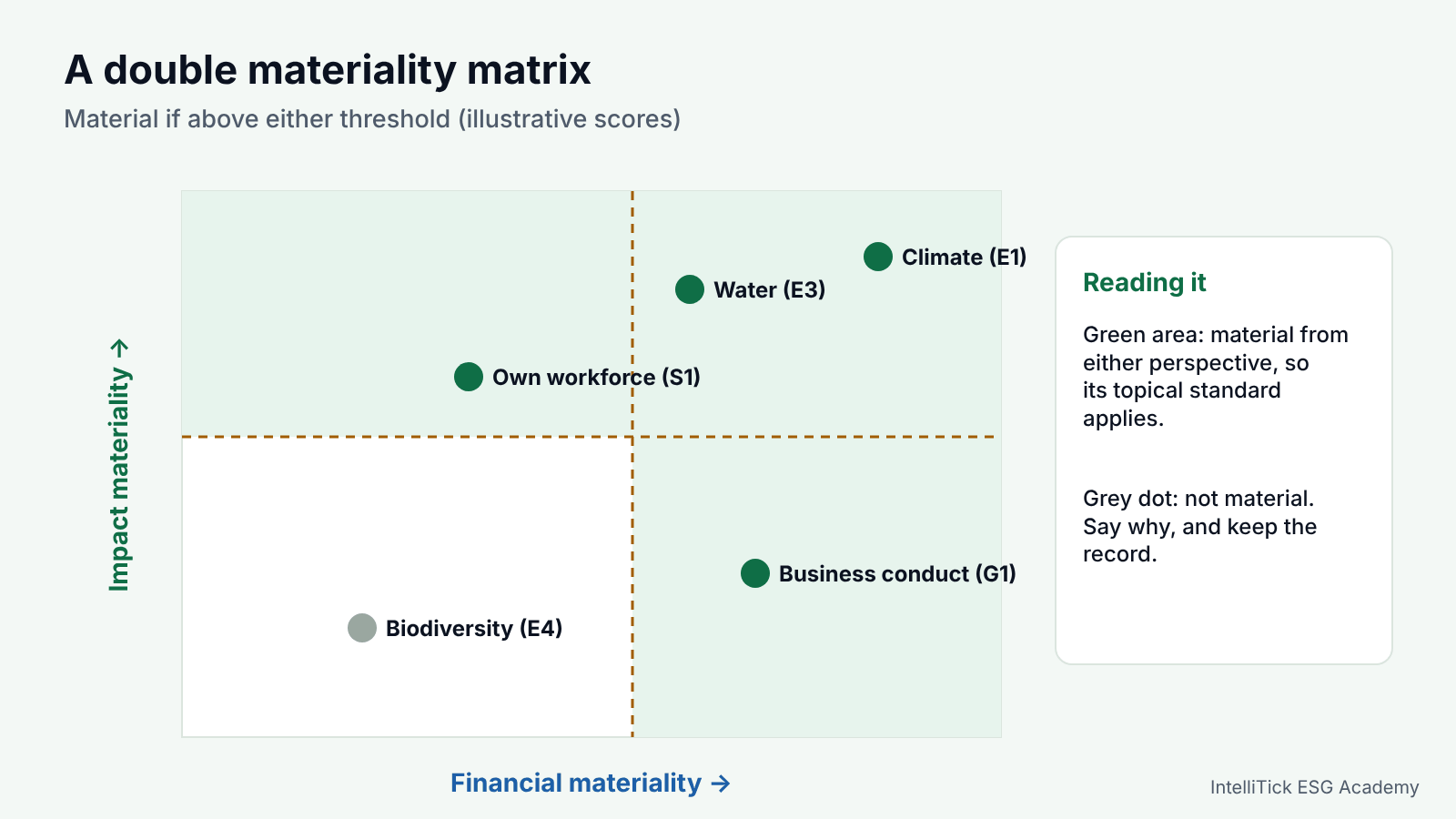
Double materiality decides what a company reports under the ESRS. A sustainability matter is material if it is material from the impact perspective, the financial perspective, or both.4
ESRS 2 sets the disclosures every company makes, whatever its materiality assessment: how sustainability is governed, how it shapes strategy and the business model, how impacts, risks and opportunities are identified an…
Climate change is material for most companies, and E1 is the most data-intensive standard. The other environmental standards — pollution, water, biodiversity, resource use — apply where the materiality assessment finds …
The social standards cover the people affected by the company — its own workforce (S1), workers in its value chain (S2), affected communities (S3) and consumers and end-users (S4). G1 covers business conduct.
Companies that report under the CSRD need data from their value chain — and they ask their suppliers. The Omnibus limits what they may demand from smaller ones.
Three requirements surround the sustainability statement: limited assurance, digital tagging and — for companies in scope — EU Taxonomy reporting. Behind them sit national filing rules and national penalties.
An Indian group that already prepares a BRSR has a strong start on the ESRS: much of the data is the same. The gaps are in double materiality, value-chain coverage, forward-looking information and some definitions.
Kaveri Industries Ltd is a fictional Indian maker of specialty chemicals and packaging films. The figures are illustrative. Work through the tasks before opening each model answer.
The reference you will come back to: the vocabulary of CSRD reporting, and a checklist for each stage of the first year.
Opens when every lesson is completed. 20 questions, 40 minutes, 70% to pass.
Sign in with your e-mail to record your progress and take the exam. Reading the lessons needs no sign-in.
What ESG is, who asks for it, how the frameworks and laws fit together, and how to start working in it — with Indian examples.

Prepare, check and file India's BRSR and BRSR Core: every section and calculation, assurance, the government filings behind the data, and the penalties to avoid.

Calculate Scope 1, 2 and 3 emissions under the GHG Protocol with Indian factors, build an inventory an assurer can test, and meet PAT, CCTS and CBAM.

Apply IFRS S1 and S2 — governance, strategy, risk management, metrics and targets — and build an IFRS S2 report on top of the BRSR.

Report a company's impacts with the GRI Standards: GRI 1, 2 and 3, material topics, the topic standards and the content index.
ESGTrack prepares BRSR, CSRD and ISSB reports from approved data, with an audit trail an assurer can test.