
In this lesson you will learn to
- Apply the thresholds to EU companies and groups
- Apply the rules for non-EU groups, including Indian groups with EU subsidiaries and branches
- Work out the first reporting year
- Explain the transitional options for companies that already reported
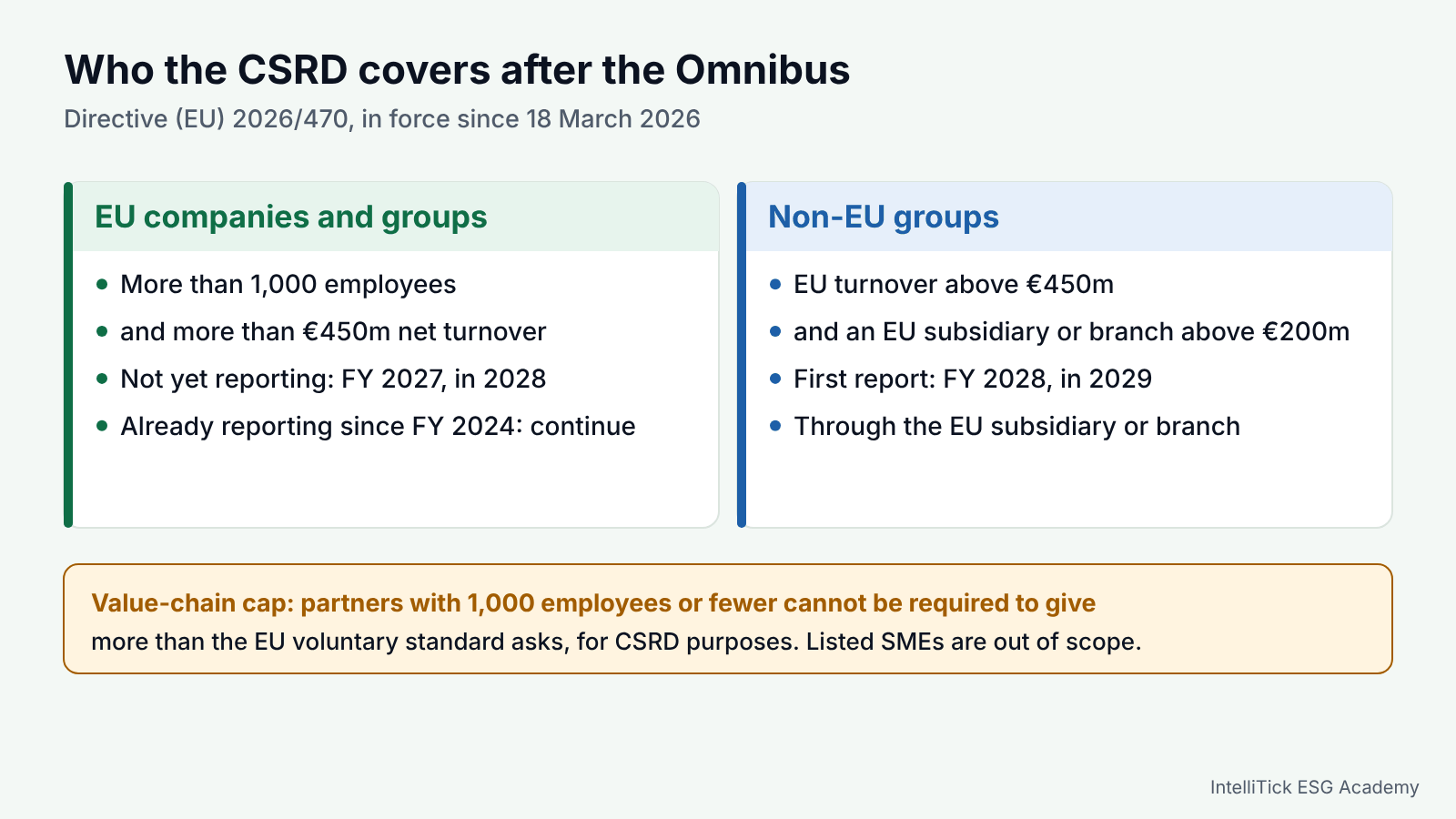
Since the Omnibus directive entered into force on 18 March 2026, the CSRD applies to EU companies and groups with more than 1,000 employees and more than €450 million in net turnover, and to large non-EU groups13.
| Before the Omnibus | After Directive (EU) 2026/470 | |
|---|---|---|
| EU companies | Large companies (two of: 250 employees, €50m turnover, €25m balance sheet) and listed SMEs | More than 1,000 employees and more than €450m net turnover |
| Listed SMEs | In scope | Removed |
| Non-EU groups | EU turnover above €150m | EU turnover above €450m, with an EU subsidiary or branch above €200m |
Sources: the directive and Accountancy Europe's factsheet13.
When reports are due
- Companies already reporting on financial year 2024 continue, though member states may exempt those below the new thresholds for FY 2025 and FY 20263.
- Large EU companies not yet reporting report on FY 2027, in 20283.
- Non-EU groups report on FY 2028, in 2029, through their EU subsidiary or branch3.
- Member states have until 19 March 2027 to bring the Omnibus changes into national law2.
Groups and subsidiaries
- A parent in scope reports on a consolidated basis for the group.
- A subsidiary that is itself in scope is generally exempt if it is included in a consolidated sustainability statement of its parent prepared under the ESRS (or an equivalent standard) — the exemption has conditions; check them.
- A non-EU group in scope reports through its EU subsidiary or branch, at group level; this is separate from any EU subsidiary's own obligation, which a group-level report does not satisfy8.
Practice
In or out, and when?
For each company, decide whether it is in scope after the Omnibus and, if so, its first reporting year:
- A Spanish listed company with 320 employees and €90 million turnover.
- An Italian manufacturer with 2,400 employees and €610 million turnover that has never reported.
- A Belgian company with 1,600 employees and €380 million turnover.
- A Japanese group with €700 million EU turnover, whose largest EU subsidiary has €150 million turnover and an EU branch with €60 million.
Show the model answer
- Out. Listed SMEs and companies below both thresholds were removed from scope.
- In. Both thresholds exceeded; a company not yet reporting reports on FY 2027, in 2028.
- Out. More than 1,000 employees, but turnover below €450 million — both must be exceeded.
- Out, on these figures: EU turnover exceeds €450 million, but no EU subsidiary or branch exceeds €200 million. Check the figures every year — a subsidiary crossing €200 million would bring the group in.
Check your understanding
Choose an answer to see if you are right.
Sources for this lesson
- Directive (EU) 2026/470 (the sustainability Omnibus) — EUR-Lex. 24 February 2026; checked November 2026
- EU Sustainability Omnibus published in the Official Journal — Latham & Watkins. 2026; checked November 2026
- Omnibus explained — CSRD factsheet — Accountancy Europe. 29 January 2026; checked November 2026
- Heads Up: EU sustainability reporting — Omnibus and the revised ESRS — Deloitte. 17 July 2026; checked November 2026
Completing every lesson opens the exam and the certificate. Sign in with your e-mail to record your progress — no password and no account.
More: CSRD and ESRS practice questions · notes (PDF) · ESG glossary