Skip to content

CSRD and ESRS practice questions with answers

12 multiple-choice questions from the free course CSRD and ESRS: the complete practitioner course. Choose an answer to see at once whether it is right, and why. The certificate exam draws different questions.
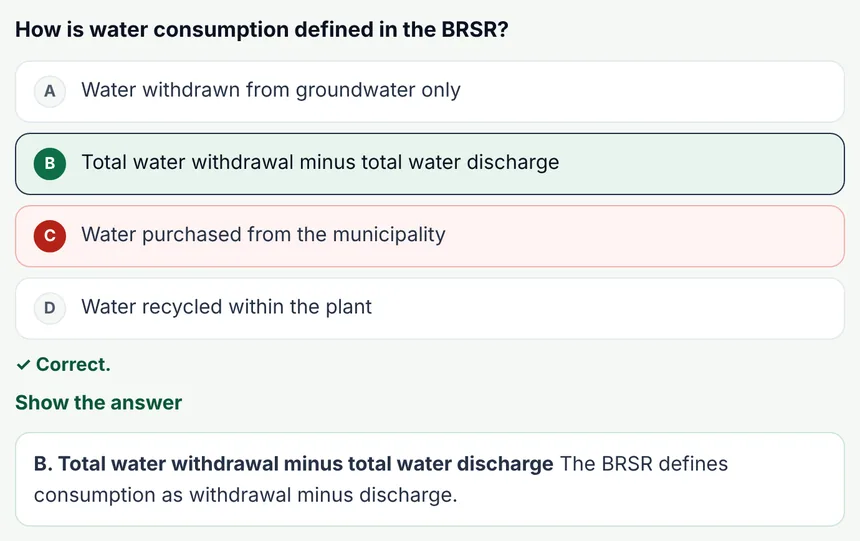
A practice question answered, with the right option marked and the reason shown

Illustrative image

Question 1 of 12
Which assurance does the CSRD require on the sustainability statement after the Omnibus?

Show the answer

B. Limited assurance The Omnibus kept limited assurance and removed the path to reasonable assurance.

From lesson 1: What the CSRD is, and how the rules fit together

Question 2 of 12
An EU company has 1,400 employees and €300 million turnover. Is it in the CSRD's scope after the Omnibus?

Show the answer

B. No: it needs both more than 1,000 employees and more than €450 million turnover Both thresholds must be exceeded. €300 million is below €450 million.

From lesson 2: Who reports after the Omnibus, and from when

Question 3 of 12
Which ESRS does every company in scope report, whatever its materiality assessment?

Show the answer

B. ESRS 2 general disclosures The cross-cutting ESRS 2 applies to every company; topical standards follow the materiality assessment.

From lesson 3: The ESRS: architecture and what the revision changed

Question 4 of 12
A matter is above the impact threshold but below the financial threshold. Is it material under the ESRS?

Show the answer

A. Yes: material from either perspective is enough Under double materiality, a matter is material if it is material from either perspective.

From lesson 4: Double materiality in depth

Question 5 of 12
For each material topic, what four kinds of information should a reader find?

Show the answer

B. Policies, actions, targets and metrics The ESRS ask for policies, actions, targets and metrics for each material topic.

From lesson 5: ESRS 2: governance, strategy and the management of IROs

Question 6 of 12
Which Scope 2 figures does E1 ask for?

Show the answer

C. Both location-based and market-based E1 asks for gross Scope 2 by both methods, measured with the GHG Protocol.

From lesson 6: Climate (E1) and the other environmental standards

Question 7 of 12
Which standard covers payment practices towards suppliers?

Show the answer

C. G1 G1 business conduct covers the management of relationships with suppliers, including payment practices.

From lesson 7: Own workforce, value chain, communities, consumers and business conduct

Question 8 of 12
An Indian supplier with 600 employees is asked by an EU customer for 300 datapoints beyond the voluntary standard, for the customer's CSRD report. What can it do?

Show the answer

B. It may decline requests beyond the voluntary standard, as a protected undertaking Companies with 1,000 employees or fewer are protected by the value-chain cap.

From lesson 8: Value chain information and the value-chain cap

Question 9 of 12
Which three KPIs does EU Taxonomy reporting use for a non-financial company?

Show the answer

B. Turnover, capital expenditure and operating expenditure The Taxonomy KPIs are the aligned shares of turnover, CapEx and OpEx.

From lesson 9: Assurance, digital tagging and the EU Taxonomy

Question 10 of 12
Which BRSR item is the closest starting point for an ESRS double materiality assessment?

Show the answer

B. Section A item 26, material issues Item 26 lists material issues; the ESRS ask for a far fuller, documented double materiality assessment.

From lesson 10: From BRSR to ESRS: a roadmap for Indian groups

Question 11 of 12
Kaveri's EU subsidiary has 840 employees and €310 million turnover; the group's EU turnover is €560 million. Who is in scope?

Show the answer

B. The group, as a non-EU group, reporting through the subsidiary from FY 2028 The subsidiary is below both thresholds, but the group exceeds €450 million EU turnover with an EU subsidiary above €200 million.

From lesson 11: Case study: Kaveri Industries' first ESRS statement

Question 12 of 12
What is a "protected undertaking"?

Show the answer

B. A value-chain company with 1,000 employees or fewer, covered by the value-chain cap Protected undertakings may decline requests beyond the voluntary standard.

From lesson 12: Glossary and checklists