
Free GHG Accounting notes
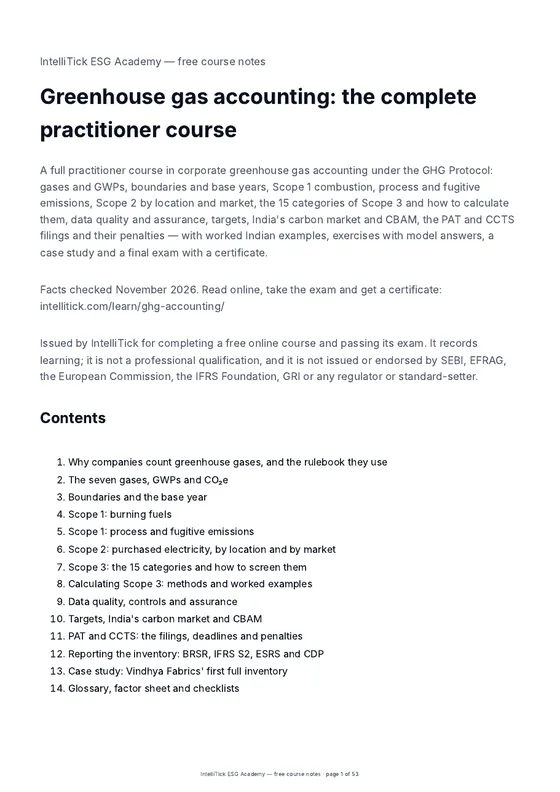
Every lesson of Greenhouse gas accounting: the complete practitioner course in one PDF — diagrams, worked examples, exercises with model answers and sources. Free, no sign-in.
Illustrative image
What the notes cover
Module 1 — Foundations
- Why companies count greenhouse gases, and the rulebook they useExplain what a corporate GHG inventory is and who asks for one; Name the GHG Protocol standards and what each covers; Describe how the standards are changing in 2026–2028; List the five accounting principles and apply them to a decision.
- The seven gases, GWPs and CO₂eName the seven greenhouse gases an inventory must cover; Convert any gas to CO₂e with the right GWP; Choose and disclose a GWP set (AR4, AR5 or AR6) and use fossil or non-fossil methane correctly; Calculate the GWP of a refrigerant blend.
- Boundaries and the base yearChoose between equity share, financial control and operational control, and apply the choice to joint ventures, leases and subsidiaries; Set the operational boundary — what is Scope 1, 2 and 3; Choose a base year and write a recalculation policy; Decide when a structural change requires recalculation.
Module 2 — Scope 1 and Scope 2
- Scope 1: burning fuelsIdentify stationary and mobile combustion sources; Convert fuel quantities to energy with net calorific values, and to CO₂ with emission factors; Handle fuels billed in MMBTU on a gross calorific value basis; Choose between default and site-specific factors, and document the choice.
- Scope 1: process and fugitive emissionsRecognise process emissions in cement, lime, steel, chemicals and glass; Calculate refrigerant emissions from service records or a mass balance; Account for SF₆, waste water and other fugitive sources; Decide which sources are material enough to measure carefully.
- Scope 2: purchased electricity, by location and by marketCalculate location-based Scope 2 with the CEA grid factor; Calculate market-based Scope 2 from contracts, green tariffs and certificates, and apply the quality criteria; Treat captive, open-access and on-site renewable power correctly; Explain where the market-based rules are heading.
Module 3 — Scope 3
- Scope 3: the 15 categories and how to screen themName and describe the 15 Scope 3 categories and their boundaries; Decide which categories are relevant for a business, using the Standard's criteria; Avoid double counting between scopes and between categories; Explain what the Scope 3 Standard requires to be reported.
- Calculating Scope 3: methods and worked examplesChoose between supplier-specific, hybrid, average-data and spend-based methods; Calculate categories 1, 4, 5, 6 and 7 with worked examples; Assess data quality and plan to improve it; Run a supplier engagement that produces usable data.
Module 4 — Quality, targets and reporting
- Data quality, controls and assuranceWrite an inventory management plan that makes the figures repeatable; Keep a factor register and handle estimates and gaps correctly; Prepare for verification or assurance of an inventory; Recognise the errors assurers find most often.
- Targets, India's carbon market and CBAMSet an emissions target with the right base year, scope and metric; Explain the SBTi's Corporate Net-Zero Standard and its new version; Explain how India's Carbon Credit Trading Scheme sets intensity targets; Explain what CBAM asks of Indian exporters to the EU.
- PAT and CCTS: the filings, deadlines and penaltiesName the forms a designated consumer files under PAT, with their due dates and the penalties for missing them; Follow the CCTS compliance cycle for an obligated entity — registry, monitoring plan, verified emission report, Form A, verification, surrender and Form D; Calculate the carbon credit certificates an obligated entity must surrender or will earn; Keep the PAT, CCTS and corporate inventories reconciled.
- Reporting the inventory: BRSR, IFRS S2, ESRS and CDPMap one inventory to the BRSR, IFRS S2, the ESRS and CDP; Present the inventory with the disclosures readers need; Keep one set of numbers behind every report.
Module 5 — Capstone
- Case study: Vindhya Fabrics' first full inventoryBuild a complete Scope 1, 2 and 3 inventory for one company; Make and justify boundary decisions; Calculate with site-specific and default data, and document every factor; Interpret the result for targets, India's carbon market and customers.
Reference
- Glossary, factor sheet and checklistsUse the vocabulary of carbon accounting precisely; Keep a working factor sheet and conversion table; Run an inventory year with a checklist.
Test yourself with the GHG Accounting practice questions, then take the exam for a free certificate you can add to LinkedIn.
Start the courseFacts checked November 2026. Rules change: check the cited source before relying on a date or threshold. Issued by Intellitick for completing a free online course and passing its exam. It records learning; it is not a professional qualification, and it is not issued or endorsed by SEBI, EFRAG, the European Commission, the IFRS Foundation, GRI or any regulator or standard-setter.