Skip to content

GHG Accounting practice questions with answers

14 multiple-choice questions from the free course Greenhouse gas accounting: the complete practitioner course. Choose an answer to see at once whether it is right, and why. The certificate exam draws different questions.
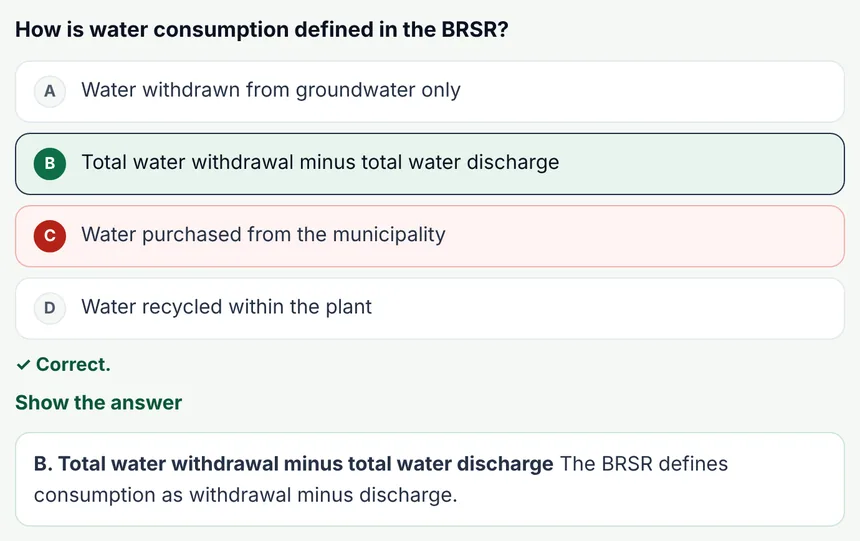
A practice question answered, with the right option marked and the reason shown

Illustrative image

Question 1 of 14
Which of these is not one of the GHG Protocol's five accounting principles?

Show the answer

C. Profitability The five principles are relevance, completeness, consistency, transparency and accuracy.

From lesson 1: Why companies count greenhouse gases, and the rulebook they use

Question 2 of 14
What does CO₂e allow a company to do?

Show the answer

B. Add different greenhouse gases together on one scale, using their global warming potentials Each gas is converted to carbon dioxide equivalent with its GWP, so the inventory can be added up.

From lesson 2: The seven gases, GWPs and CO₂e

Question 3 of 14
Which event does not trigger a base-year recalculation?

Show the answer

C. Higher production at an existing plant Organic growth or decline is not a reason to recalculate the base year.

From lesson 3: Boundaries and the base year

Question 4 of 14
Indian natural gas is billed in MMBTU on a gross calorific value basis. What must you do before applying an IPCC CO₂ factor?

Show the answer

B. Convert MMBTU to GJ and gross to net calorific value IPCC factors are per unit of net calorific value, so the gross figure in the bill must be converted.

From lesson 4: Scope 1: burning fuels

Question 5 of 14
Refrigerant leaking from the company's own chillers is…

Show the answer

A. Scope 1, as fugitive emissions Leaks from equipment the company owns or controls are direct, fugitive Scope 1 emissions.

From lesson 5: Scope 1: process and fugitive emissions

Question 6 of 14
A company buys renewable energy certificates covering all its electricity. What happens to its location-based Scope 2?

Show the answer

B. It does not change: location-based uses the grid's average factor Certificates affect the market-based figure; the location-based figure always uses the grid average.

From lesson 6: Scope 2: purchased electricity, by location and by market

Question 7 of 14
Which Scope 3 category is usually largest for a bank?

Show the answer

C. Category 15, investments (financed emissions) A bank's lending and investments carry the emissions of the companies it finances, which usually dwarf its own.

From lesson 7: Scope 3: the 15 categories and how to screen them

Question 8 of 14
Which Scope 3 method multiplies money spent by an environmentally extended input-output factor?

Show the answer

C. Spend-based The spend-based method uses spend × EEIO factors; it is quick but sensitive to prices.

From lesson 8: Calculating Scope 3: methods and worked examples

Question 9 of 14
A figure of 120,000 kWh is multiplied by a factor of 0.710 tCO₂/MWh and gives 85,200 tCO₂. What went wrong?

Show the answer

B. The units: 120,000 kWh is 120 MWh, so the answer is 85.2 tCO₂ The kWh were not converted to MWh, making the answer 1,000 times too large.

From lesson 9: Data quality, controls and assurance

Question 10 of 14
Does buying carbon credits reduce a company's reported Scope 1 emissions?

Show the answer

B. No: gross emissions are reported, and credits are reported separately Credits are not reductions in the inventory; frameworks require them to be reported separately.

From lesson 10: Targets, India's carbon market and CBAM

Question 11 of 14
Under the CCTS, how is the number of carbon credit certificates to surrender calculated?

Show the answer

B. (GEI achieved − GEI target) × output in the compliance year BEE's compliance procedure sets the surrender quantity as the gap between achieved and target intensity, multiplied by output.

From lesson 11: PAT and CCTS: the filings, deadlines and penalties

Question 12 of 14
Which Scope 2 figure does IFRS S2 require?

Show the answer

B. Location-based, with information on contractual instruments IFRS S2 requires location-based Scope 2 and information about contractual instruments needed to understand the market-based picture.

From lesson 12: Reporting the inventory: BRSR, IFRS S2, ESRS and CDP

Question 13 of 14
Under operational control, how does a joint venture operated by the partner appear in the company's inventory?

Show the answer

C. Not in Scope 1 and 2; in Scope 3, category 15 (investments) Under operational control, operations the company does not operate are excluded from Scope 1 and 2 and reported in Scope 3, category 15.

From lesson 13: Case study: Vindhya Fabrics' first full inventory

Question 14 of 14
How many GJ is 1 MMBTU?

Show the answer

B. 1.0551 1 MMBTU equals 1.0551 GJ.

From lesson 14: Glossary, factor sheet and checklists