
In this lesson you will learn to
- Calculate location-based Scope 2 with the CEA grid factor
- Calculate market-based Scope 2 from contracts, green tariffs and certificates, and apply the quality criteria
- Treat captive, open-access and on-site renewable power correctly
- Explain where the market-based rules are heading
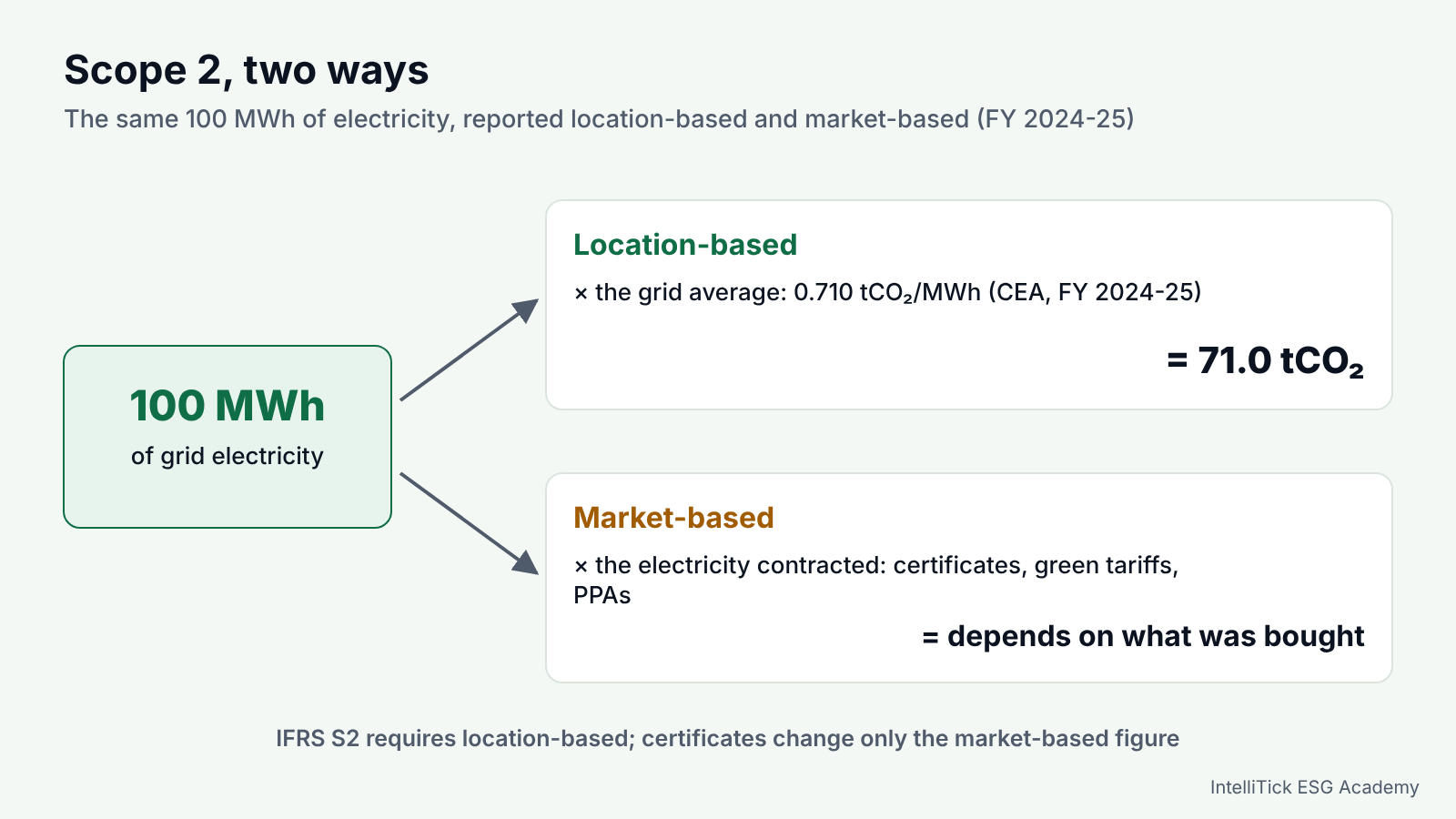
Scope 2 is the emissions from generating the electricity, steam, heat and cooling a company buys and uses. Since 2015, a company that can buy specific electricity reports it two ways — by location and by market2.
Location-based
The location-based method uses the average emission intensity of the grid where the electricity is consumed2. In India, that is the Central Electricity Authority's CO2 Baseline Database. Version 22 gives weighted averages of 0.727 tCO₂/MWh for FY 2023-24 and 0.710 for FY 2024-255. The factor changes every year, covers CO₂ only, and is published after the year it describes — so use the latest available, and say which version.
Market-based
The market-based method uses the emissions of the electricity the company has chosen to buy, through contractual instruments2:
- energy attribute certificates — in India, Renewable Energy Certificates (RECs), and international certificates (I-RECs);
- green tariffs offered by the distribution company;
- power purchase agreements (PPAs), including open-access supply from a renewable generator;
- supplier-specific emission rates.
The Scope 2 Guidance sets quality criteria: the instrument must convey the emission rate, be the only claim on that electricity (no double counting), be retired or cancelled for the company, match the period of consumption as closely as possible, and come from the same market as the consumption. For electricity not covered by instruments, the company uses a residual mix factor; where none exists — as in India — it uses the grid average and says so2.
Common Indian situations
| Situation | Location-based | Market-based |
|---|---|---|
| Grid electricity, no contract | Grid factor | Grid factor (no residual mix available) |
| Green tariff from the distribution company | Grid factor | Zero for the covered MWh, if the tariff meets the criteria |
| Open-access renewable power (wheeled through the grid) | Grid factor — it is delivered through the grid | Zero for the contracted MWh, with the attributes retained |
| On-site solar, not exported | Not Scope 2 at all: no purchase | Not Scope 2 |
| Captive gas or diesel generation | Fuel is Scope 1; not Scope 2 | Same |
| RECs bought separately from the power | Grid factor | Zero for the MWh covered by retired RECs |
Which figure to report where. IFRS S2 requires location-based Scope 2, with information on contractual instruments7. The BRSR asks for Scope 2 without naming a method6: state which you report, and keep it the same each year.
The market-based method is changing
The GHG Protocol consulted from October 2025 to January 2026 on requiring market-based claims to be matched hour by hour and deliverable to the grid where the electricity is used. In 2026 its Independent Standards Board moved towards two market-based methods — one with hourly matching, deliverability and incrementality, one keeping the 2015 rules — with the transition date still to be decided10. Until new rules are published, the 2015 Guidance applies; keep hourly consumption data where you can, because it is likely to be needed.
Practice
Both Scope 2 figures
A plant used 30,000 MWh in FY 2025-26: 20,000 MWh from the grid on the standard tariff, 4,000 MWh on the distribution company's green tariff, and 6,000 MWh of solar power through an open-access PPA with the renewable attributes transferred to the plant. It also generated 1,500 MWh from rooftop solar. Use 0.710 tCO₂/MWh.
Calculate location-based and market-based Scope 2.
Show the model answer
- Location-based: all grid-delivered electricity carries the grid factor: (20,000 + 4,000 + 6,000) × 0.710 = 21,300 tCO₂. The rooftop solar is not purchased, so it is not in Scope 2.
- Market-based: the green tariff and the PPA are zero if they meet the quality criteria; the standard-tariff electricity uses the grid average (no Indian residual mix): 20,000 × 0.710 = 14,200 tCO₂.
- Report both, state the instruments and the factor version, and note that the market-based figure uses the grid average for the uncovered MWh because no residual mix is published.
Check your understanding
Choose an answer to see if you are right.
Sources for this lesson
- GHG Protocol Scope 2 Guidance — WRI and WBCSD. January 2015; checked November 2026
- CO2 Baseline Database for the Indian Power Sector, User Guide, Version 22.0 — Central Electricity Authority. August 2026; checked November 2026
- Master Circular for compliance with the SEBI (LODR) Regulations, 2015 — Annexures 16 and 17A — SEBI (copy published by NSDL). 30 January 2026; checked November 2026
- IFRS S2: Climate-related Disclosures — IFRS Foundation. June 2023, as amended December 2025; checked November 2026
- Scope 2 market-based method update — GHG Protocol. 6 October 2026; checked November 2026
Completing every lesson opens the exam and the certificate. Sign in with your e-mail to record your progress — no password and no account.
More: GHG Accounting practice questions · notes (PDF) · ESG glossary