
In this lesson you will learn to
- Choose between supplier-specific, hybrid, average-data and spend-based methods
- Calculate categories 1, 4, 5, 6 and 7 with worked examples
- Assess data quality and plan to improve it
- Run a supplier engagement that produces usable data
Scope 3 can be calculated at several levels of precision. The Technical Guidance describes, for each category, a range of methods — from supplier-specific data to estimates from spend. Most inventories mix them, and improve year by year18.
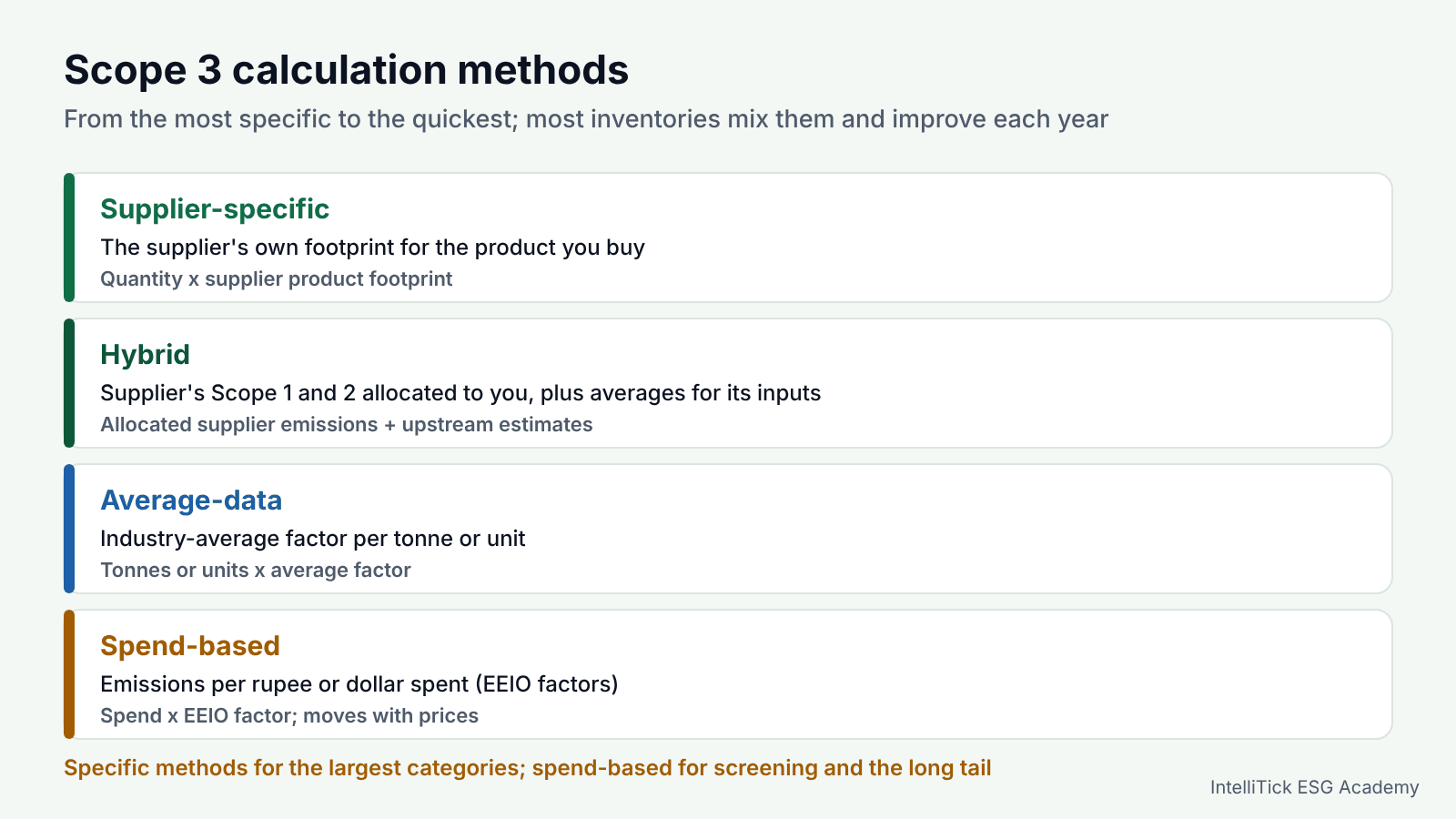
The methods for purchased goods (category 1)
| Method | Data | Formula | When |
|---|---|---|---|
| Supplier-specific | The supplier's cradle-to-gate emissions for the product | Quantity × supplier's product footprint | Key suppliers that can provide verified data |
| Hybrid | The supplier's Scope 1 and 2 allocated to your purchases, plus secondary data for its inputs | Supplier's allocated emissions + upstream estimates | Suppliers that report their own inventory |
| Average-data | Quantity (tonnes, units) × an industry-average factor per unit | Mass or units × average factor | Commodities bought by weight or count |
| Spend-based | Money spent × an environmentally extended input-output (EEIO) factor per rupee or dollar | Spend × factor | Screening; services; the long tail |
Source: Technical Guidance for Calculating Scope 3 Emissions18.
Other common categories
Category 4 — upstream transport (distance-based): tonnes × kilometres × a factor per tonne-kilometre for the mode (road, rail, sea, air).
Category 5 — waste: tonnes of each waste stream by treatment (landfill, incineration, recycling) × a factor for that treatment.
Category 6 — business travel: for flights, passenger-kilometres by class and distance band × a factor; for hotels (optional), room-nights × a factor; from the travel agency's report, not expense claims where possible.
Category 7 — employee commuting: a survey of how employees travel and how far, scaled to the workforce: employees × working days × distance × factor by mode.
Data quality
The Technical Guidance assesses data on technological, temporal, geographical, completeness and reliability dimensions18: does the factor match the material, the year, the country, the scope of activities, and is the source reliable? Keep a short data-quality note for each category, and a plan to improve the weakest large categories.
Supplier engagement
- Rank suppliers by estimated emissions (spend × factor), not spend alone.
- Ask the top suppliers for their Scope 1 and 2 inventory and their revenue, or product footprints if they have them.
- Allocate a supplier's emissions to you by your share of its revenue or output, and say which.
- Help them: share a template, a definitions sheet and, in India, the BRSR Core indicators they may already be preparing.
- Record which share of category 1 is supplier-specific each year — a number investors and SBTi ask for.
Practice
Allocate a supplier's emissions
A supplier reports Scope 1 and 2 of 48,000 tCO₂e and revenue of ₹1,200 crore. You bought ₹90 crore from it this year. What is the hybrid estimate of the emissions attributable to your purchases (its Scope 1 and 2 only), and what are its limitations?
Show the model answer
Your share of its revenue = 90 ÷ 1,200 = 7.5%. Allocated emissions = 48,000 × 7.5% = 3,600 tCO₂e.
Limitations: revenue-based allocation assumes every rupee of the supplier's sales carries the same emissions, which is wrong if your products are more (or less) energy-intensive than its average; and it covers only the supplier's Scope 1 and 2, not the emissions of the supplier's own inputs (its Scope 3), which the hybrid method adds from secondary data. An allocation by physical output — tonnes of the product you buy — is better where the supplier can provide it.
Check your understanding
Choose an answer to see if you are right.
Sources for this lesson
- Technical Guidance for Calculating Scope 3 Emissions — WRI and WBCSD. 2013; checked November 2026
Completing every lesson opens the exam and the certificate. Sign in with your e-mail to record your progress — no password and no account.
More: GHG Accounting practice questions · notes (PDF) · ESG glossary