


ESG fundamentals: the complete foundation course
What ESG is, who asks for it, how the frameworks and laws fit together, and how to start working in it — with Indian examples.
- Lessons
- 12
- Study time
- 3 hours 10 minutes
- Exercises
- 13

Free course with certificate
Report a company's impacts with the GRI Standards: GRI 1, 2 and 3, material topics, the topic standards and the content index.
Illustrative image
What the GRI Standards are, how the Universal, Sector and Topic Standards fit together, how a company decides its material topics, what reporting "in accordance with" or "with reference to" GRI means, the reporting principles, the general disclosures, the main topic standards, and how GRI connects with BRSR, the ISSB standards and the ESRS — with worked examples, exercises with model answers, a case study and a final exam with a certificate.
The GRI Standards, from the Global Reporting Initiative, are the most widely used voluntary standards for reporting a company's impacts on the economy, the environment and people.
GRI 1: Foundation sets out how to use the GRI Standards: the requirements a report must meet, and the principles that make the information high quality6.
GRI 2: General Disclosures describes the organisation: who it is, what it does, who works for it, how it is governed, its strategy and policies, and how it engages stakeholders. Every GRI report includes it7.
GRI asks a company to identify its material topics — "topics that represent the organization's most significant impacts on the economy, environment, and people" — and then report on each.1
A company can report "in accordance with" the GRI Standards, meeting all their requirements, or "with reference to" them, using selected standards for specific information. Either way, it publishes a GRI content index.
For most companies the environmental topic standards are where the figures are. Two are changing on 1 January 2027, and biodiversity changed on 1 January 2026.
The social and governance topic standards cover the people the company employs and affects, and how it conducts business. Like every topic standard, each is reported for the topics the organisation has determined to be …
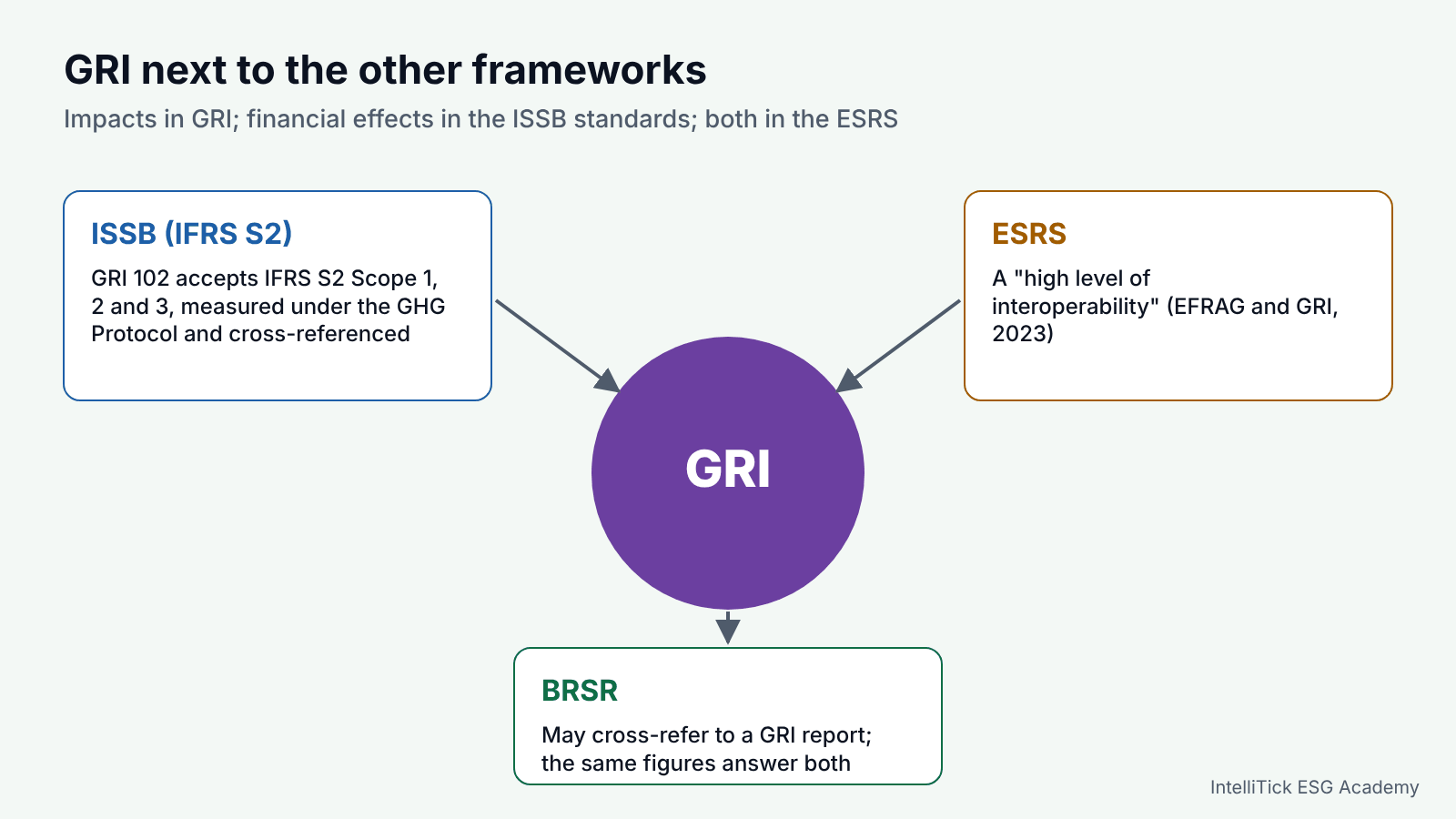
GRI covers impacts; the ISSB covers financial effects; the ESRS cover both. Recent statements make it easier to use them together.
Malabar Spices Ltd is a fictional Kerala-based spice processor and exporter, sourcing from 12,000 smallholder farmers. It wants its first report in accordance with the GRI Standards for FY 2025-26. The figures are illus…
The reference you will come back to: the GRI vocabulary, and a checklist for a GRI report.
Opens when every lesson is completed. 20 questions, 40 minutes, 70% to pass.
Sign in with your e-mail to record your progress and take the exam. Reading the lessons needs no sign-in.
What ESG is, who asks for it, how the frameworks and laws fit together, and how to start working in it — with Indian examples.

Prepare, check and file India's BRSR and BRSR Core: every section and calculation, assurance, the government filings behind the data, and the penalties to avoid.

Calculate Scope 1, 2 and 3 emissions under the GHG Protocol with Indian factors, build an inventory an assurer can test, and meet PAT, CCTS and CBAM.

Report under the CSRD and the revised ESRS after the Omnibus: who is in scope, double materiality, the standards, assurance and enforcement.

Apply IFRS S1 and S2 — governance, strategy, risk management, metrics and targets — and build an IFRS S2 report on top of the BRSR.
ESGTrack prepares BRSR, CSRD and ISSB reports from approved data, with an audit trail an assurer can test.