


ESG fundamentals: the complete foundation course
What ESG is, who asks for it, how the frameworks and laws fit together, and how to start working in it — with Indian examples.
- Lessons
- 12
- Study time
- 3 hours 10 minutes
- Exercises
- 13

Free course with certificate
Apply IFRS S1 and S2 — governance, strategy, risk management, metrics and targets — and build an IFRS S2 report on top of the BRSR.
Illustrative image
A full practitioner course on the ISSB's IFRS S1 and IFRS S2: the standards' origins and users, financial materiality and the general requirements, the four core content areas, climate governance and strategy, scenario analysis and financial effects, the cross-industry and industry metrics, greenhouse gas disclosures with the December 2025 amendments, the reliefs, adoption around the world and in India — with worked examples, exercises with model answers, a case study and a final exam with a certificate.
The International Sustainability Standards Board (ISSB), set up by the IFRS Foundation — the body behind IFRS Accounting Standards — issued its first two standards in June 2023: IFRS S1, the general requirements, and IF…
IFRS S1 sets the rules every ISSB report follows: what to disclose about sustainability-related risks and opportunities, how to decide what is material, and how the disclosures connect to the financial statements.
IFRS S1 and S2 organise disclosures in four core content areas — the same as the TCFD.
IFRS S2 applies the four areas to climate. Its heart is strategy: what climate change could do to the business, what the company is doing about it, what it means for the numbers, and whether the strategy holds up under …
IFRS S2 asks for metrics in three groups: seven cross-industry categories every company reports, industry-based metrics for the company's business, and the targets the company has set or is required to meet.
IFRS S2 requires absolute gross Scope 1, Scope 2 and Scope 3 emissions, measured with the GHG Protocol Corporate Standard, with the approach, inputs and assumptions explained29.
To help companies start, the ISSB gave several reliefs in the first year a company applies the standards; jurisdictions often add phasing of their own.
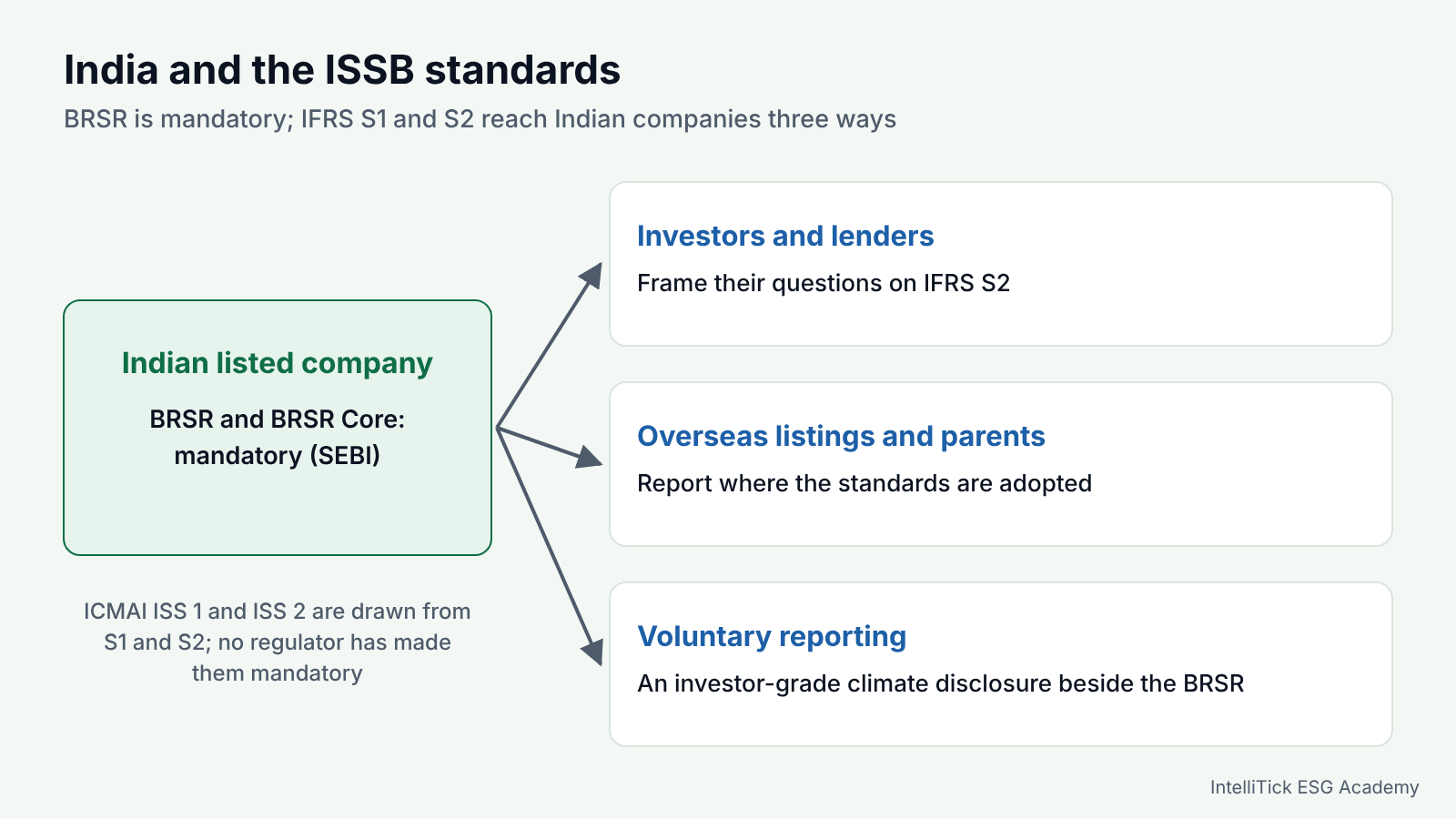
India's mandatory regime for listed companies is the BRSR and BRSR Core. The ISSB standards are not mandatory in India, but Indian companies meet them through investors, overseas listings and parents, and voluntary repo…
Godavari Power Components Ltd is a fictional Indian maker of transformers and switchgear, listed in India, with a London-listed bond whose investors ask for IFRS S2 information. The figures are illustrative.
The reference you will come back to: the vocabulary of ISSB reporting, and a checklist for a first IFRS S2 report.
Opens when every lesson is completed. 20 questions, 40 minutes, 70% to pass.
Sign in with your e-mail to record your progress and take the exam. Reading the lessons needs no sign-in.
What ESG is, who asks for it, how the frameworks and laws fit together, and how to start working in it — with Indian examples.

Prepare, check and file India's BRSR and BRSR Core: every section and calculation, assurance, the government filings behind the data, and the penalties to avoid.

Calculate Scope 1, 2 and 3 emissions under the GHG Protocol with Indian factors, build an inventory an assurer can test, and meet PAT, CCTS and CBAM.

Report under the CSRD and the revised ESRS after the Omnibus: who is in scope, double materiality, the standards, assurance and enforcement.

Report a company's impacts with the GRI Standards: GRI 1, 2 and 3, material topics, the topic standards and the content index.
ESGTrack prepares BRSR, CSRD and ISSB reports from approved data, with an audit trail an assurer can test.