Skip to content

Free course with certificate

BRSR and BRSR Core: the complete practitioner course

Prepare, check and file India's BRSR and BRSR Core: every section and calculation, assurance, the government filings behind the data, and the penalties to avoid.

Level
Beginner to professional
Lessons
18, about 7 hours 15 minutes
Worked exercises
24
Exam
20 questions, 70% to pass
Facts checked
November 2026

Illustrative image

About this course

A full practitioner course on India's Business Responsibility and Sustainability Report: the law and who files, every section and principle of the format, the calculations, BRSR Core under the Industry Standards, assessment and assurance, value chain disclosures, running the data process and filing in XBRL, the exchange fines and SEBI penalties for late or wrong filings, and the government returns behind the data (CSR, Form V, hazardous waste, EPR, PAT and CCTS, POSH) with a compliance calendar — with worked examples, exercises with model answers, a case study and a final exam with a certificate.

What you will be able to do

  • Explain who must file a BRSR, under which regulation, and what is due when
  • Read the BRSR format item by item — Section A, Section B and all nine principles — and know where each answer comes from
  • Calculate the ratios the BRSR asks for: turnover rates, LTIFR, parental-leave return rates, energy in joules, water consumption, Scope 1 and 2 emissions and PPP-adjusted intensities
  • Prepare the nine BRSR Core attributes to the Industry Standards, with the evidence an assurer will test
  • Choose between assessment and assurance, and run an engagement without surprises
  • Plan a BRSR year — owners, data requests, controls and review — and file the PDF and XBRL correctly
  • Know the government filings behind the BRSR data — CSR-2 and the Unspent CSR Account, consents, Form V, hazardous waste returns, EPR, PAT and CCTS, POSH — with their due dates and penalties, and keep a compliance calendar that avoids fines

Inside the course

Lessons

  1. Module 1 — Foundations

    About 40 minutes
  2. What the BRSR is, who files it, and when

    The Business Responsibility and Sustainability Report (BRSR) is the report in which a listed company in India sets out what it does about its environmental, social and governance responsibilities, in a format fixed by t…

    20 min

  3. How the BRSR format is built

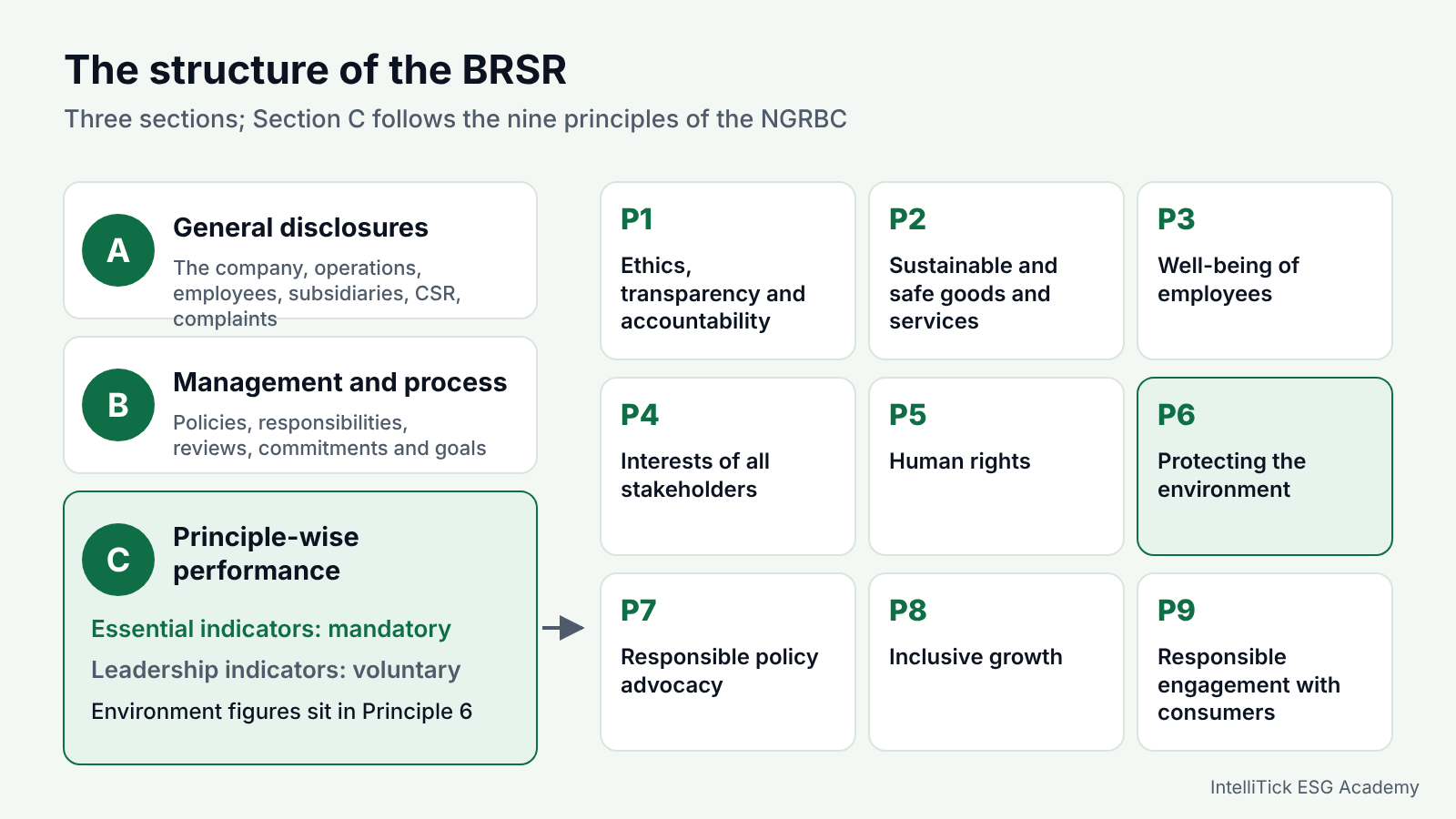
    A BRSR has three sections: general disclosures (A), management and process disclosures (B), and principle-wise performance (C) under India's nine principles of responsible business conduct.

    20 min

  4. Module 2 — The format, section by section

    About 2 hours 5 minutes
  5. Section A: general disclosures, item by item

    Section A describes the company: who it is, what it sells, where it operates, who works for it, which group it belongs to, its CSR position, the complaints it received and its material sustainability issues. It looks ad…

    20 min

  6. Section B: policies, governance and targets

    Section B asks how the company manages each of the nine principles: whether it has a policy, whether the board approved it, how it is put into practice, who is responsible, how it is reviewed, and what the company has c…

    15 min

  7. Principles 1, 2, 4 and 7: ethics, products, stakeholders and advocacy

    These four principles cover how the company conducts itself: its ethics and openness (P1), the products it makes (P2), how it engages stakeholders (P4) and how it lobbies (P7). Much of the evidence lives with the legal,…

    20 min

  8. Principles 3 and 5: people, safety and human rights

    Principle 3 covers the well-being and safety of the people who work for the company — including those in its value chain — and Principle 5 covers their human rights: training, wages, grievances, and harassment and discr…

    20 min

  9. Principle 6: energy, water, emissions and waste
    Principle 6 holds the environmental figures — energy, water, air emissions, greenhouse gases and waste — and it is where most BRSR Core assurance effort goes. Every number here should trace to a meter, a bill, a manifes…

    30 min

  10. Principles 8 and 9: communities, inclusive growth and consumers

    Principle 8 covers the company's effect on communities and inclusive growth — land, rehabilitation, grievances, local sourcing, jobs in smaller towns and CSR — and Principle 9 covers its consumers: complaints, product i…

    20 min

  11. Module 3 — BRSR Core, assurance and the value chain

    About 55 minutes
  12. BRSR Core: the nine attributes and the Industry Standards

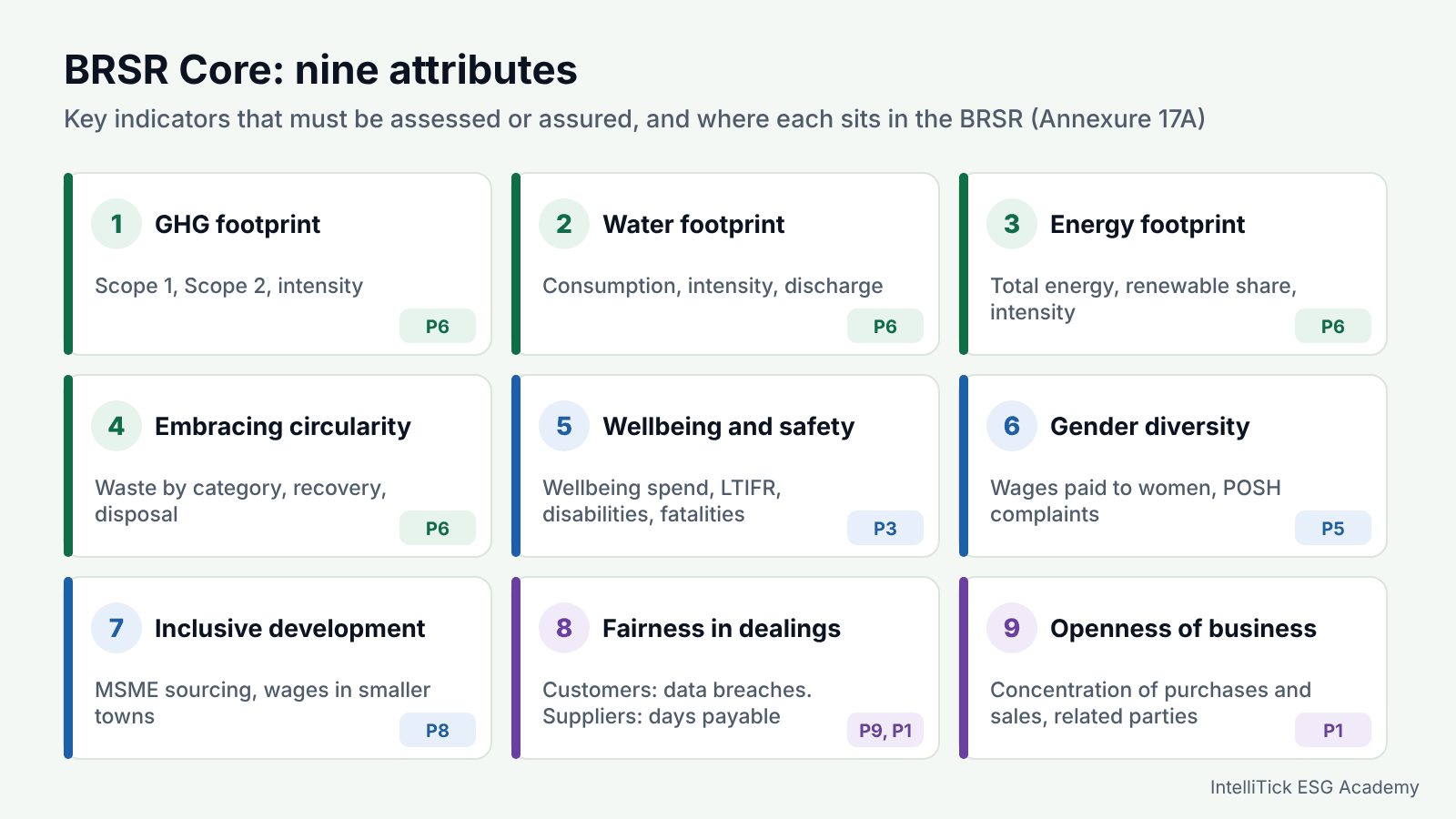
    BRSR Core is a set of key indicators drawn from the BRSR, grouped under nine attributes, that must be independently assessed or assured by the largest listed companies. SEBI introduced it in July 2023 and revised it in …

    20 min

  13. Assessment or assurance: running the engagement

    The largest listed companies must have BRSR Core independently checked. Since March 2025 they may choose an assessment or an assurance. The choice, the provider and the preparation decide whether the engagement is routi…

    20 min

  14. Value chain disclosures and green credits

    The BRSR can also cover a company's value chain — its largest suppliers and customers. Since 2025 this is voluntary, and limited to the partners that matter most.

    15 min

  15. Module 4 — Doing the work

    About 2 hours 35 minutes
  16. Running a BRSR year: owners, data and controls

    Most of the work of a BRSR is not the writing. It is getting figures from every site and function, each approved with its evidence, before the report is assembled. This lesson is the playbook.

    20 min

  17. Filing the BRSR: PDF and XBRL

    The BRSR is part of the annual report, and it is filed with the stock exchanges as a PDF and in XBRL, a machine-readable format, on the same day as the annual report.

    15 min

  18. Late, missing or wrong: exchange fines and SEBI penalties

    The BRSR is part of the annual report, so a late or missing BRSR is a late or incomplete annual report. The stock exchanges fine that by the day, escalate unpaid fines step by step, and SEBI can add penalties of its own.

    30 min

  19. The government filings behind the BRSR data

    Most of the figures in a BRSR have already been reported to a government authority — CSR spending to the Registrar of Companies, water and waste to the State Pollution Control Board, plastic to the CPCB, energy to the B…

    60 min

  20. A compliance calendar and penalty-avoidance checklist

    Penalties are rarely about difficult rules. They are about dates nobody owned. A one-page calendar, with an owner for every line, prevents most of them.

    30 min

  21. Module 5 — Capstone

    About 55 minutes
  22. Case study: preparing Sahyadri Polymers' BRSR Core

    This case study brings the course together. Sahyadri Polymers Ltd is a fictional mid-sized manufacturer of plastic compounds; the figures are illustrative but realistic. Work through the five tasks before opening each m…

    55 min

  23. Reference

    About 5 minutes
  24. Glossary, checklists and where to look

    This lesson is the reference you will come back to: the terms, the checklists and the sources.

    5 min

  25. Final exam and certificate

    Opens when every lesson is completed. 20 questions, 40 minutes, 70% to pass.

Sign in with your e-mail to record your progress and take the exam. Reading the lessons needs no sign-in.

Sources used in this course

  1. SEBI circular: Business responsibility and sustainability reporting by listed entities (SEBI/HO/CFD/CMD-2/P/CIR/2021/562) — SEBI (copy published by NSE). 10 May 2021; checked November 2026
  2. Master Circular for compliance with the SEBI (LODR) Regulations, 2015 — Chapter IV-B and Annexures 16, 17 and 17A — SEBI (copy published by NSDL). 30 January 2026; checked November 2026
  3. SEBI (LODR) (Amendment) Regulations, 2024: average market capitalisation for applicability — Taxmann summary. 2024; checked November 2026
  4. FAQs on filing of BRSR (NSE/CML/2024/11) — National Stock Exchange of India. 10 May 2024; checked November 2026
  5. SEBI circular on assessment or assurance, value chain disclosures and green credits (SEBI/HO/CFD/CFD-PoD-1/P/CIR/2025/42) — SEBI. 28 March 2025; checked November 2026
  6. SEBI circular: BRSR Core – Framework for assurance and ESG disclosures for value chain (SEBI/HO/CFD/CFD-SEC-2/P/CIR/2023/122) — SEBI. 12 July 2023; checked November 2026
  7. Emerging trends in BRSR reporting by listed companies — KPMG in India. February 2026; checked November 2026
  8. SEBI circular: Industry Standards on Reporting of BRSR Core (SEBI/HO/CFD/CFD-PoD-1/P/CIR/2024/177) — SEBI (copy published by NSE). 20 December 2024; checked November 2026
  9. Industry Standards on Reporting of BRSR Core — Industry Standards Forum (ASSOCHAM, CII, FICCI), published by NSE. December 2024; checked November 2026
  10. Guidance note for the Business Responsibility and Sustainability Report (Annexure II to the circular of 10 May 2021) — SEBI. 10 May 2021; checked November 2026
  11. CO2 Baseline Database for the Indian Power Sector, User Guide, Version 22.0 — Central Electricity Authority. August 2026; checked November 2026
  12. ICAI rolls out SSA 5000 to align India's sustainability assurance with global norms from April 2027 — CAalley (news report). 21 September 2026; checked November 2026
  13. New labour codes implemented across the country effective 21 November 2025 — EY India. November 2025; checked November 2026
  14. GHG Protocol Corporate Accounting and Reporting Standard, Revised Edition — WRI and WBCSD. 2004; checked November 2026
  15. The Securities and Exchange Board of India Act, 1992 (sections 15A and 15HB) — Government of India (India Code). as amended; checked November 2026
  16. Guidance note on SEBI's standard operating procedure for fines and suspension (equity) — National Stock Exchange of India. 4 May 2026; checked November 2026
  17. Companies (Corporate Social Responsibility Policy) Amendment Rules, 2021: summary — ICAI (Navi Mumbai branch). January 2021; checked November 2026
  18. Corporate social responsibility under the Companies Act, 2013 (presentation) — Institute of Company Secretaries of India. checked November 2026
  19. Companies (Accounts) Second Amendment Rules, 2023 (G.S.R. 408(E)): Form CSR-2 filed separately — Gazette of India. 31 May 2023; checked November 2026
  20. ROC penalises company and officers for not transferring unspent CSR amount (section 135(6) and (7)) — Taxmann. 19 September 2023; checked November 2026
  21. The Environment (Protection) Rules, 1986 (rule 14: environmental statement in Form V) — Ministry of Environment, Forest and Climate Change. as amended; checked November 2026
  22. Jan Vishwas (Amendment of Provisions) Bill, 2022, as passed by Lok Sabha: amendments to the Environment (Protection) Act and the Air Act — PRS Legislative Research. July 2023; checked November 2026
  23. The Water (Prevention and Control of Pollution) Amendment Act, 2024 — Gazette of India. 15 February 2024; checked November 2026
  24. Hazardous and Other Wastes (Management and Transboundary Movement) Rules, 2016: forms and timelines — Tamil Nadu Pollution Control Board. checked November 2026
  25. The Sexual Harassment of Women at Workplace (Prevention, Prohibition and Redressal) Act, 2013, and Rules — Government of India (copy published by Delhi Police). checked November 2026
  26. An overview of extended producer responsibility for plastic waste management — Chambers and Partners. 2026; checked November 2026
  27. CPCB compliance status in O.A. No. 993 of 2024 (plastic packaging EPR) — National Green Tribunal (filing by CPCB). 6 July 2026; checked November 2026
  28. EPR guidance manual for producers under the Battery Waste Management Rules, 2022 — Punjab Pollution Control Board. checked November 2026
  29. PAT Rules and obligations of designated consumers under the PAT scheme — Bureau of Energy Efficiency. checked November 2026
  30. Detailed procedure for the compliance mechanism under the Carbon Credit Trading Scheme — Bureau of Energy Efficiency (copy published by DevelopmentAid). 2025; checked November 2026
  31. Environmental statements: Form V (see rule 14) — Odisha State Pollution Control Board. checked November 2026
  32. Form 4: Form for filing annual returns (Hazardous and Other Wastes Rules, 2016) — Puducherry Pollution Control Committee. checked November 2026
  33. e-Form CSR-2: report on corporate social responsibility (presentation) — Institute of Company Secretaries of India. 2022; checked November 2026

Report it with the evidence behind every figure

ESGTrack prepares BRSR, CSRD and ISSB reports from approved data, with an audit trail an assurer can test.