
In this lesson you will learn to
- List the nine BRSR Core attributes and the indicators under each
- Explain what the Industry Standards are and why they bind
- Convert revenue to PPP terms and calculate the intensity ratios
- Know when spend-based estimates are allowed, and when they are not
BRSR Core is a set of key indicators drawn from the BRSR, grouped under nine attributes, that must be independently assessed or assured by the largest listed companies. SEBI introduced it in July 2023 and revised it in March 202565. Since FY 2024-25, companies must prepare it to the Industry Standards on Reporting of BRSR Core8.
The nine attributes
| # | Attribute | Indicators | Where in the BRSR |
|---|---|---|---|
| 1 | Green-house gas (GHG) footprint | Scope 1; Scope 2; GHG intensity (Scope 1 + 2) per rupee of turnover PPP-adjusted and per unit of output | P6, essential 7 |
| 2 | Water footprint | Water consumption; water intensity; water discharge by destination and treatment | P6, essential 3 and 4 |
| 3 | Energy footprint | Total energy consumed; percentage from renewable sources; energy intensity | P6, essential 1 |
| 4 | Embracing circularity | Waste generated by category A–H; waste intensity; recovery by type; disposal by method | P6, essential 9 |
| 5 | Enhancing employee wellbeing and safety | Spending on well-being as % of revenue; LTIFR; permanent disabilities; fatalities | P3, essential 1(c) and 11 |
| 6 | Enabling gender diversity in business | Gross wages paid to women as % of total wages; POSH complaints — total, % of women, upheld | P5, essential 3(b) and 7 |
| 7 | Enabling inclusive development | Inputs from MSMEs and small producers, and from within India; wages paid in smaller towns | P8, essential 4 and 5 |
| 8 | Fairness in engaging with customers and suppliers | Customer data breaches as % of cyber security events; days of accounts payable | P9, essential 7; P1, essential 8 |
| 9 | Open-ness of business | Concentration of purchases and sales; related-party shares | P1, essential 9 |
Source: Annexure 17A2.
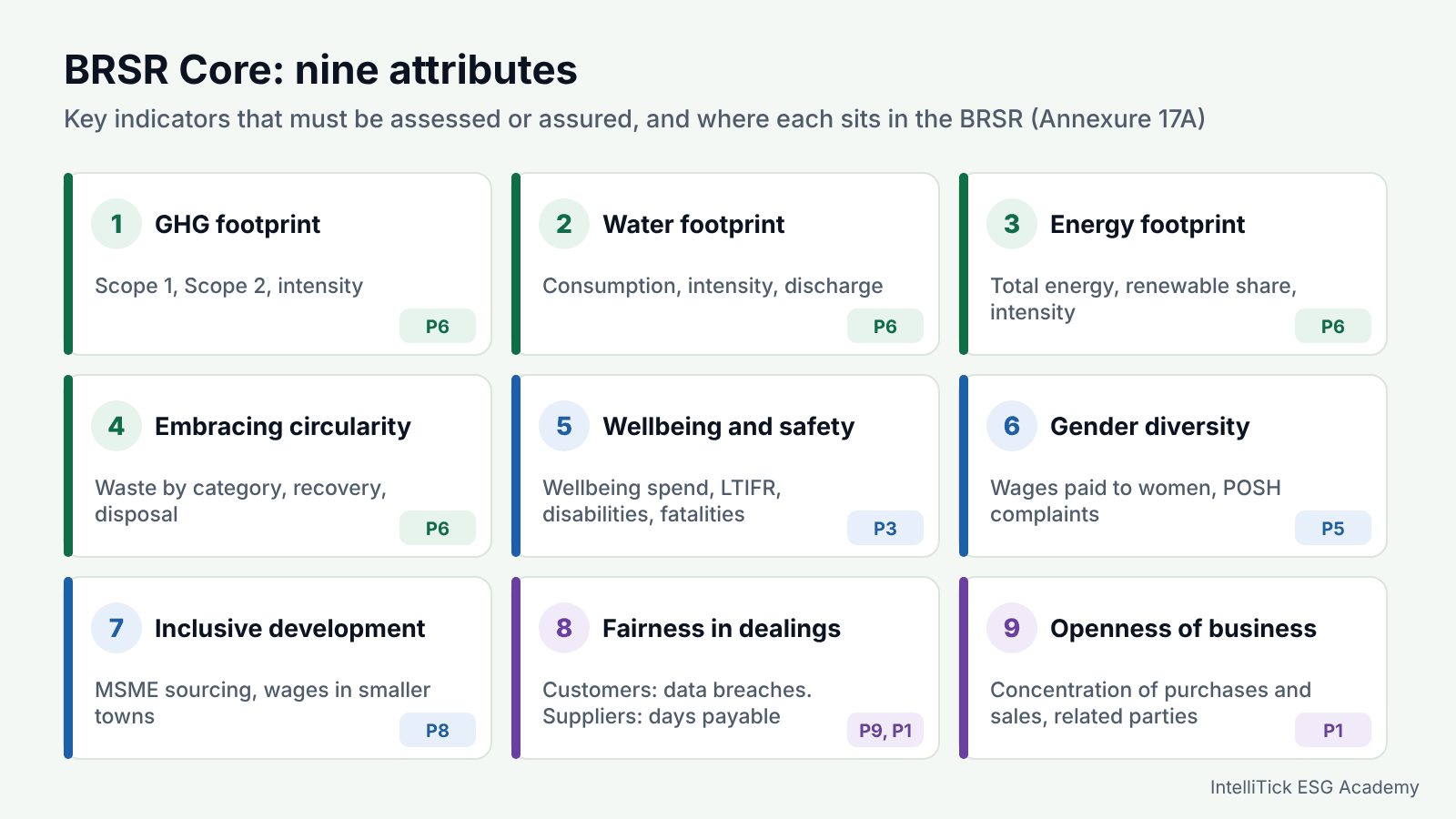
The phase-in by size band2:

The Industry Standards
The Industry Standards were written by the Industry Standards Forum — representatives of ASSOCHAM, CII and FICCI — under the aegis of the stock exchanges and in consultation with SEBI. SEBI's circular of 20 December 2024 made them binding: listed companies must follow them for BRSR Core, from FY 2024-258. They settle the questions the format leaves open — data sources, formulas and estimates — and the previous lessons have used them throughout. The main rules in one place9:
| Topic | Rule |
|---|---|
| Intensity | Per rupee of turnover adjusted for PPP, and per unit of output — production for manufacturers, full-time equivalents for services |
| PPP | Revenue in rupees ÷ the IMF's PPP conversion factor for India; use the latest, and disclose it |
| Emission factors | From an accredited laboratory, IPCC, IEA, UK DEFRA, US EPA or a country-specific source, disclosed; latest CEA factor for Indian grid power |
| Estimates | Spend-based estimates only where measured data is not available, with the method disclosed — and no going back to spend-based once measured data has been reported |
| Water without meters | 45 litres per head per working day; shared buildings allocated by floor area |
| Energy | Purchased power split into wheeled renewable, wheeled non-renewable, green tariff and grid |
| Well-being, gender, MSME, smaller towns, data breaches, payables, openness | As in the previous lessons |
Intensity ratios with PPP
Revenue in PPP terms = revenue from operations in rupees ÷ PPP conversion factor (rupees per international dollar).
The Industry Standards' own worked example uses 22.4 rupees per international dollar — the IMF figure for India as of April 2024 — and divides ₹10,000 million by 22.4 to get about 446 million9. For your own report, take the latest IMF figure and state it.
When estimates are acceptable
Estimates are allowed but disciplined. A spend-based estimate — rupees spent on diesel divided by a price per litre, multiplied by an emission factor — is a stop-gap for sites without quantity data, and the Industry Standards include a provisional method for it9. Their limits matter: prices vary with contracts, only CO₂ is captured, and refrigerants and process emissions are missed. Use it, label it, and replace it with measured data as soon as you can.
Practice
Compute the GHG and energy attributes
Use the plant from the Principle 6 exercise (energy 1,70,905 GJ; diesel 4,10,000 litres; natural gas 18,50,000 scm; grid electricity 18,400 MWh). Revenue from operations ₹1,640 crore. Production 2,46,000 tonnes.
Illustrative factors: diesel 2.68 kg CO₂ per litre; natural gas 2.07 kg CO₂ per scm; grid 0.710 tCO₂ per MWh (CEA, FY 2024-25); PPP 22.4 rupees per international dollar.
Calculate Scope 1, Scope 2, GHG intensity per million PPP dollars and per tonne of product, and energy intensity per million PPP dollars.
Show the model answer
- Scope 1 = (4,10,000 × 2.68 + 18,50,000 × 2.07) ÷ 1,000 = (10,98,800 + 38,29,500) kg ÷ 1,000 = 4,928 tCO₂e (refrigerant leaks and process emissions would be added if present).
- Scope 2 = 18,400 × 0.710 = 13,064 tCO₂e, treating the open-access wind power (with its contractual evidence) and the on-site solar as zero-emission — a market-based treatment the company must state. On the location-based method the wind power, delivered through the grid, would add 3,500 × 0.710 = 2,485 tCO₂e. The greenhouse gas accounting course explains both methods.
- Scope 1 + 2 = 17,992 tCO₂e.
- Revenue in PPP terms = ₹1,640 crore ÷ 22.4 = $732.1 million.
- GHG intensity = 17,992 ÷ 732.1 = 24.6 tCO₂e per million PPP dollars; per tonne of product = 17,992 ÷ 2,46,000 = 0.073 tCO₂e per tonne.
- Energy intensity = 1,70,905 GJ ÷ 732.1 = 233 GJ per million PPP dollars.
Check your understanding
Choose an answer to see if you are right.
Sources for this lesson
- Master Circular for compliance with the SEBI (LODR) Regulations, 2015 — Chapter IV-B and Annexures 16, 17 and 17A — SEBI (copy published by NSDL). 30 January 2026; checked November 2026
- SEBI circular on assessment or assurance, value chain disclosures and green credits (SEBI/HO/CFD/CFD-PoD-1/P/CIR/2025/42) — SEBI. 28 March 2025; checked November 2026
- SEBI circular: BRSR Core – Framework for assurance and ESG disclosures for value chain (SEBI/HO/CFD/CFD-SEC-2/P/CIR/2023/122) — SEBI. 12 July 2023; checked November 2026
- SEBI circular: Industry Standards on Reporting of BRSR Core (SEBI/HO/CFD/CFD-PoD-1/P/CIR/2024/177) — SEBI (copy published by NSE). 20 December 2024; checked November 2026
- Industry Standards on Reporting of BRSR Core — Industry Standards Forum (ASSOCHAM, CII, FICCI), published by NSE. December 2024; checked November 2026
Completing every lesson opens the exam and the certificate. Sign in with your e-mail to record your progress — no password and no account.
More: BRSR practice questions · notes (PDF) · ESG glossary