
In this lesson you will learn to
- Name the three sections and the nine NGRBC principles
- Tell essential indicators from leadership indicators
- Read the BRSR tables correctly, including units and previous-year columns
- Locate any topic — energy, wages, complaints — in the format within seconds
A BRSR has three sections: general disclosures (A), management and process disclosures (B), and principle-wise performance (C) under India's nine principles of responsible business conduct.
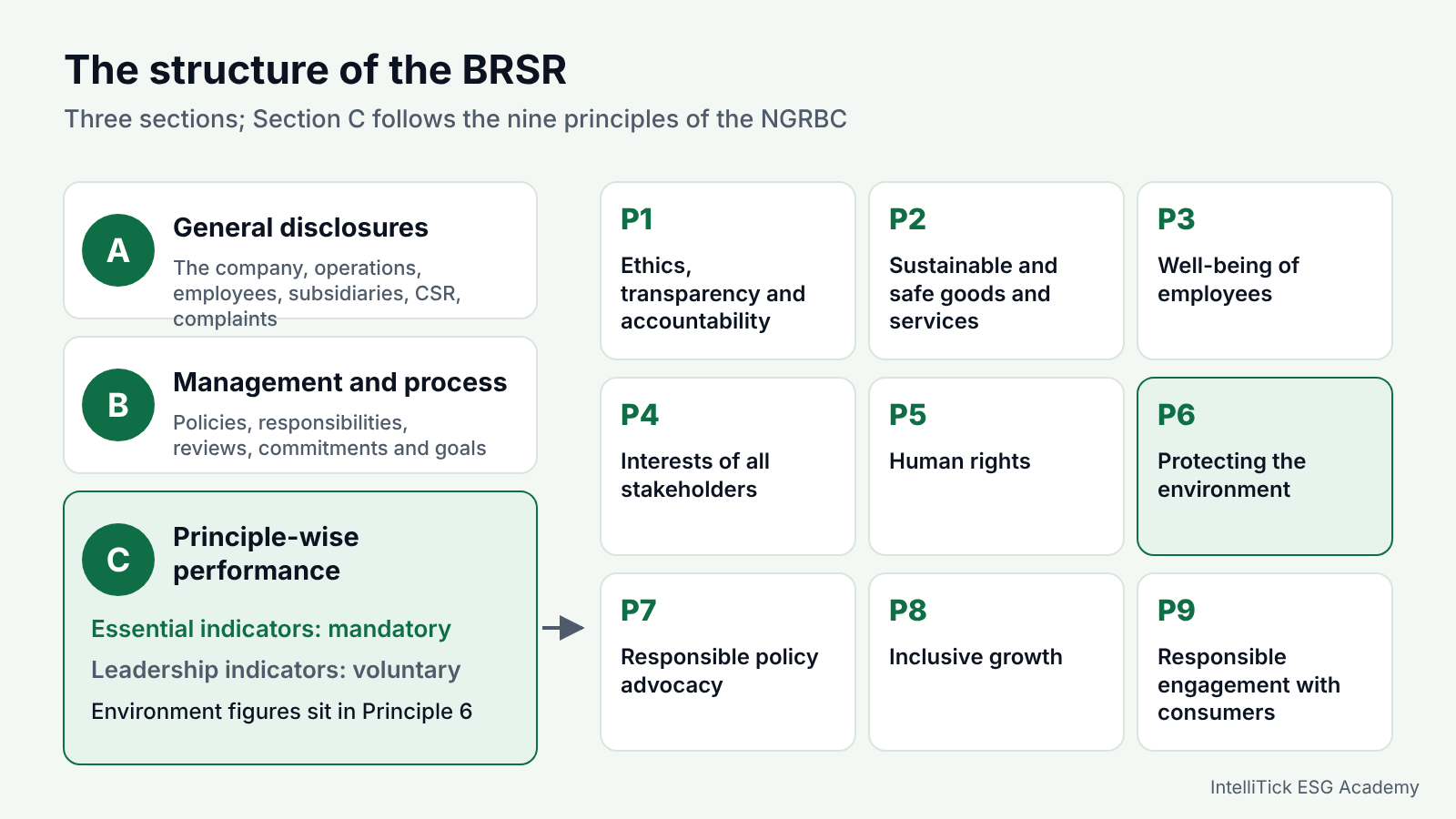
The three sections
| Section | Items | What it covers |
|---|---|---|
| A — General disclosures | 26 | The company, its products and operations, its people, its group, CSR, complaints and its material issues2 |
| B — Management and process disclosures | 12 | Policies for each principle, who is responsible, how they are reviewed, commitments and targets2 |
| C — Principle-wise performance | Nine principles | The indicators — figures and descriptions — for each principle |
The nine principles
Section C follows the nine principles of the National Guidelines on Responsible Business Conduct (NGRBC), issued by the Ministry of Corporate Affairs in 2019. Learn them in order — practitioners refer to "P6 essential indicator 7" rather than "the emissions table":
| Principle (short name) | What you will find there | |
|---|---|---|
| P1 | Ethics, transparency and accountability | Training on the principles, fines and penalties, anti-corruption, conflicts of interest, days payable, concentration of purchases and sales |
| P2 | Sustainable and safe goods and services | R&D and capex on better technologies, sustainable sourcing, take-back of products, Extended Producer Responsibility |
| P3 | Well-being of employees, including in the value chain | Benefits, retirement benefits, accessibility, parental leave, unions, training, safety incidents |
| P4 | Responsiveness to all stakeholders | How stakeholders are identified and engaged |
| P5 | Human rights | Human rights training, minimum and median wages, complaints, POSH |
| P6 | Protecting and restoring the environment | Energy, water, air emissions, greenhouse gases, waste, environmental compliance |
| P7 | Responsible public policy advocacy | Trade associations, anti-competitive conduct |
| P8 | Inclusive growth and equitable development | Social impact assessments, rehabilitation, community grievances, sourcing from MSMEs, jobs in smaller towns, CSR |
| P9 | Responsible engagement with consumers | Complaints, product information, recalls, cyber security and data breaches |
Essential and leadership indicators
Each principle has essential indicators, which are mandatory, and leadership indicators, which are voluntary1. Answering leadership indicators signals maturity — Scope 3 emissions, for example, are a leadership indicator under P6 — but an unanswered leadership indicator is not a breach. An unanswered essential indicator is.
Reading the tables
Four habits avoid most errors:
- Two years side by side. Most tables have a current financial year (FY) and previous FY column. The previous-year figures should match what you filed last year, unless you restate them and say why.
- Units are part of the answer. Energy is in joules or multiples (GJ, TJ), emissions in tonnes of CO₂ equivalent, water in kilolitres, waste in metric tonnes2. Converting kWh to joules is your job, not the reader's.
- Intensities need both denominators. Since FY 2023-24, intensity figures (energy, water, emissions, waste) are given per rupee of turnover adjusted for purchasing power parity (PPP), and optionally per unit of physical output2. Lesson 9 shows the calculation.
- "Not applicable" needs a reason. An item marked not applicable must say why, in the PDF and in the XBRL4.
Practice
Find it in the format
Without looking back, name the section and, where relevant, the principle in which each of these is reported:
- The number of plants the company operates.
- The company's anti-bribery policy.
- Scope 3 emissions.
- Complaints from investors.
- The median remuneration of women employees.
- Percentage of inputs bought from MSMEs.
- Whether the board has a committee responsible for sustainability.
- Data breaches involving customers' personal information.
Show the model answer
- Section A, item 18 (operations).
- Section C, Principle 1 (essential indicator 4).
- Section C, Principle 6 — a leadership indicator, so voluntary.
- Section A, item 25 (complaints by stakeholder group).
- Section C, Principle 5 (essential indicator 3).
- Section C, Principle 8 (essential indicator 4) — also a BRSR Core indicator.
- Section B, item 9.
- Section C, Principle 9 (essential indicator 7) — also a BRSR Core indicator.
Check your understanding
Choose an answer to see if you are right.
Sources for this lesson
- SEBI circular: Business responsibility and sustainability reporting by listed entities (SEBI/HO/CFD/CMD-2/P/CIR/2021/562) — SEBI (copy published by NSE). 10 May 2021; checked November 2026
- Master Circular for compliance with the SEBI (LODR) Regulations, 2015 — Chapter IV-B and Annexures 16, 17 and 17A — SEBI (copy published by NSDL). 30 January 2026; checked November 2026
- FAQs on filing of BRSR (NSE/CML/2024/11) — National Stock Exchange of India. 10 May 2024; checked November 2026
Completing every lesson opens the exam and the certificate. Sign in with your e-mail to record your progress — no password and no account.
More: BRSR practice questions · notes (PDF) · ESG glossary