
In this lesson you will learn to
- Plan a BRSR cycle month by month
- Build an indicator owner matrix and a data request that sites can answer
- Set up the controls — evidence, review, approval and change records — that make the report assurable
- Reuse last year's report without copying its mistakes
Most of the work of a BRSR is not the writing. It is getting figures from every site and function, each approved with its evidence, before the report is assembled. This lesson is the playbook.
The year at a glance
| When (March year end) | What happens |
|---|---|
| April–May | Close last year's lessons learned; confirm boundary, owners and changes to the format; agree the assurance or assessment provider |
| Monthly, April–March | Sites and functions enter activity data with evidence; first-level review at site |
| Quarterly | Central review of trends and gaps; fix definitions early; update the board committee |
| January–February | Draft narrative answers (Section B, P4, P7, policies); collect leadership indicators |
| April (after year end) | Final data, year-end HR and finance figures, reconciliations; data freeze |
| April–June | Assurance or assessment fieldwork; responses to queries; final figures |
| Before the annual report | Board committee review; prepare PDF and XBRL from the same final figures; file |
The owner matrix
Every indicator needs one owner who provides the figure, one reviewer who checks it, and one approver. A short extract:
| Indicator | Owner | Reviewer | Source |
|---|---|---|---|
| P6 E1 energy | Plant utilities head, each site | Corporate energy manager | Electricity bills, fuel logs, generation meters |
| P6 E3–E4 water | Plant EHS | Corporate EHS | Flow meter logs, municipal bills |
| P6 E7 Scope 1 and 2 | Corporate sustainability | Finance controller | Energy data, factor register |
| P6 E9 waste | Plant EHS | Corporate EHS | Manifests, recycler certificates |
| P3 E11 safety | Plant safety officer | Corporate safety head | Incident register, hours from gate system |
| P5 E3 wages and medians | HR payroll | Finance | Payroll register, audited figures |
| P8 E4 MSME sourcing | Procurement | Finance | Vendor master, purchase ledger |
| P1 E8–E9 payables, openness | Finance | Company secretary | Audited accounts, related-party register |
| P9 E7 data breaches | Chief information security officer | Legal | CERT-In incident log |
The data request
A data request that gets usable answers states, for each item: the definition (quoting the BRSR or Industry Standards wording), the unit, the period (monthly), the evidence to attach, the owner, and the deadline. Sites should enter data where the review happens — in one system or one controlled workbook — not by e-mailing spreadsheets that are pasted together at year end.
Controls that make the report assurable
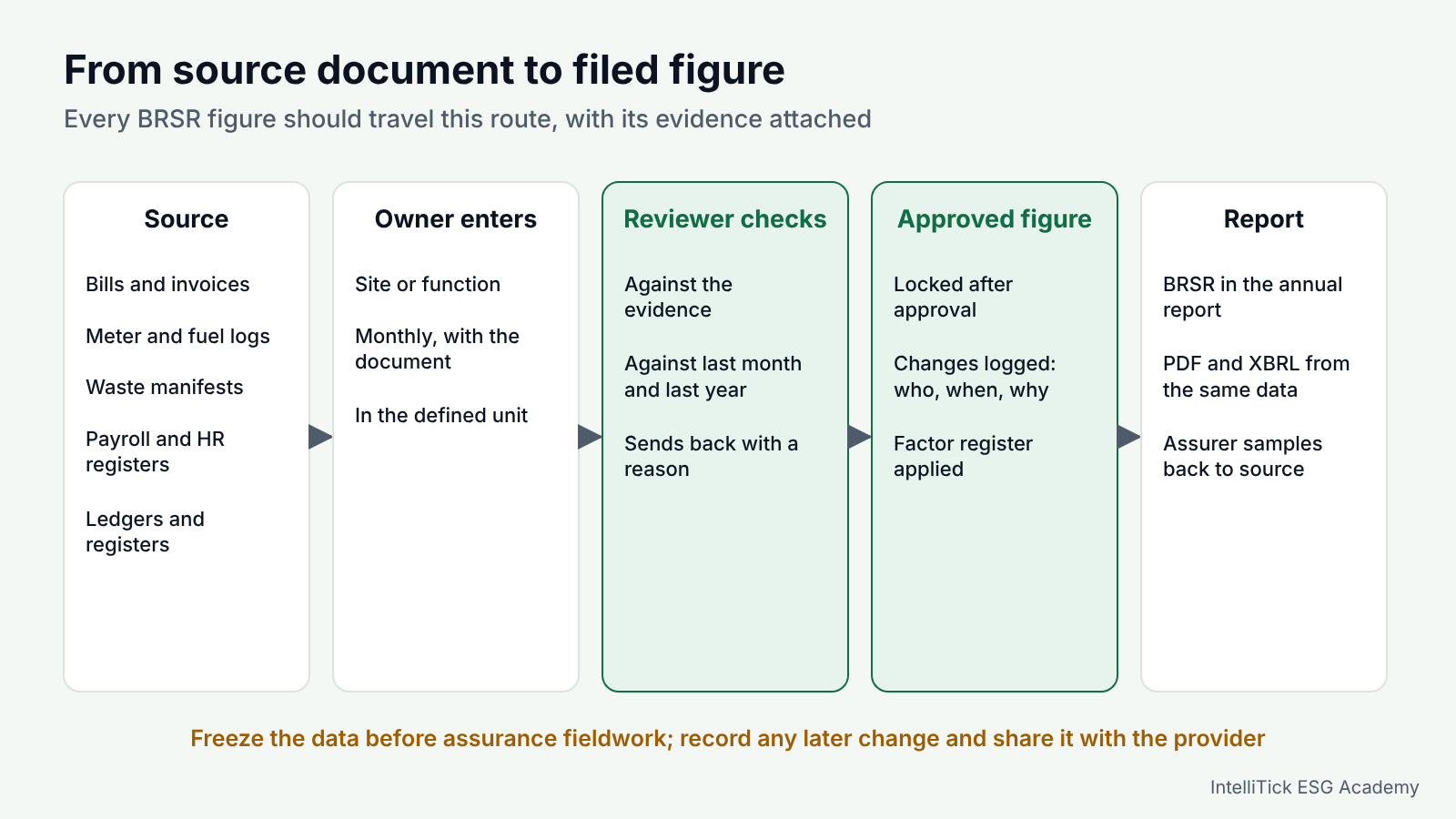
- Evidence with every figure. The bill, log or certificate is attached when the figure is entered.
- Two people for every figure. A preparer and a reviewer; the reviewer checks the evidence, the unit and the trend.
- Reasons for every rejection and every change. A figure sent back carries the reason; a figure changed after approval carries who, when and why.
- A factor register. Every emission factor and calorific value with its source, year and unit — the Industry Standards require the source to be disclosed, and the latest CEA factor for grid power9.
- A data freeze. After the freeze, changes go through a documented process — so the figures the assurer tested are the figures you file.
- Reconciliations. Revenue, wages, purchases and payables reconciled to the audited financial statements.
Reusing last year's report
Start from last year's filed BRSR, not a blank page — but treat every answer as a draft:
- Policies: are the links still live, and have any been revised or newly approved?
- Targets: report progress honestly against what you committed to in Section B item 5.
- Comparatives: last year's figures should match the filed report, or be restated with an explanation.
- Format changes: check the latest master circular and exchange notices for amendments.
Practice
Spot the control failures
In a review meeting you learn:
- The Pune plant's electricity for October was entered as 1,240,000 instead of 1,240 MWh; nobody noticed until the annual total looked high.
- The water figures for three plants were estimated by the sustainability team in March "because the meter logs were not sent".
- After the assurer finished sampling, the HR team updated the headcount, which changed the turnover rates.
- The Scope 2 calculation uses the CEA factor from version 19 for all years.
For each, name the control that failed and what should change.
Show the model answer
- Unit error at Pune — review control failed. A reviewer checking the figure against the bill and against the trend (October versus September) would have caught a thousand-fold jump. Introduce a monthly review with variance checks, and fix the unit in the entry form (MWh only).
- Estimated water — evidence control failed. Figures were entered without source documents, and estimated without labelling. Require meter logs as attachments; where an estimate is unavoidable, use the method in the Industry Standards and label it as an estimate.
- Headcount changed after fieldwork — data freeze failed. Changes after the freeze must be documented and shared with the assurer, who may need to re-test. Agree the freeze date with HR and finance.
- Old CEA factor — factor register failed. The Industry Standards require the latest CEA factor. Maintain a factor register with version and year, and update it each time CEA publishes a new version.
Check your understanding
Choose an answer to see if you are right.
Sources for this lesson
- Industry Standards on Reporting of BRSR Core — Industry Standards Forum (ASSOCHAM, CII, FICCI), published by NSE. December 2024; checked November 2026
Completing every lesson opens the exam and the certificate. Sign in with your e-mail to record your progress — no password and no account.
More: BRSR practice questions · notes (PDF) · ESG glossary