
In this lesson you will learn to
- Identify which partners are value chain partners under the 2025 rules
- Decide how far down the list disclosure must go
- Plan a supplier data request that partners can actually answer
- Report green credits under Principle 6
The BRSR can also cover a company's value chain — its largest suppliers and customers. Since 2025 this is voluntary, and limited to the partners that matter most.
The rules after March 2025
The July 2023 circular planned value chain disclosures on a comply-or-explain basis. The March 2025 revision made them voluntary and changed how partners are chosen52:
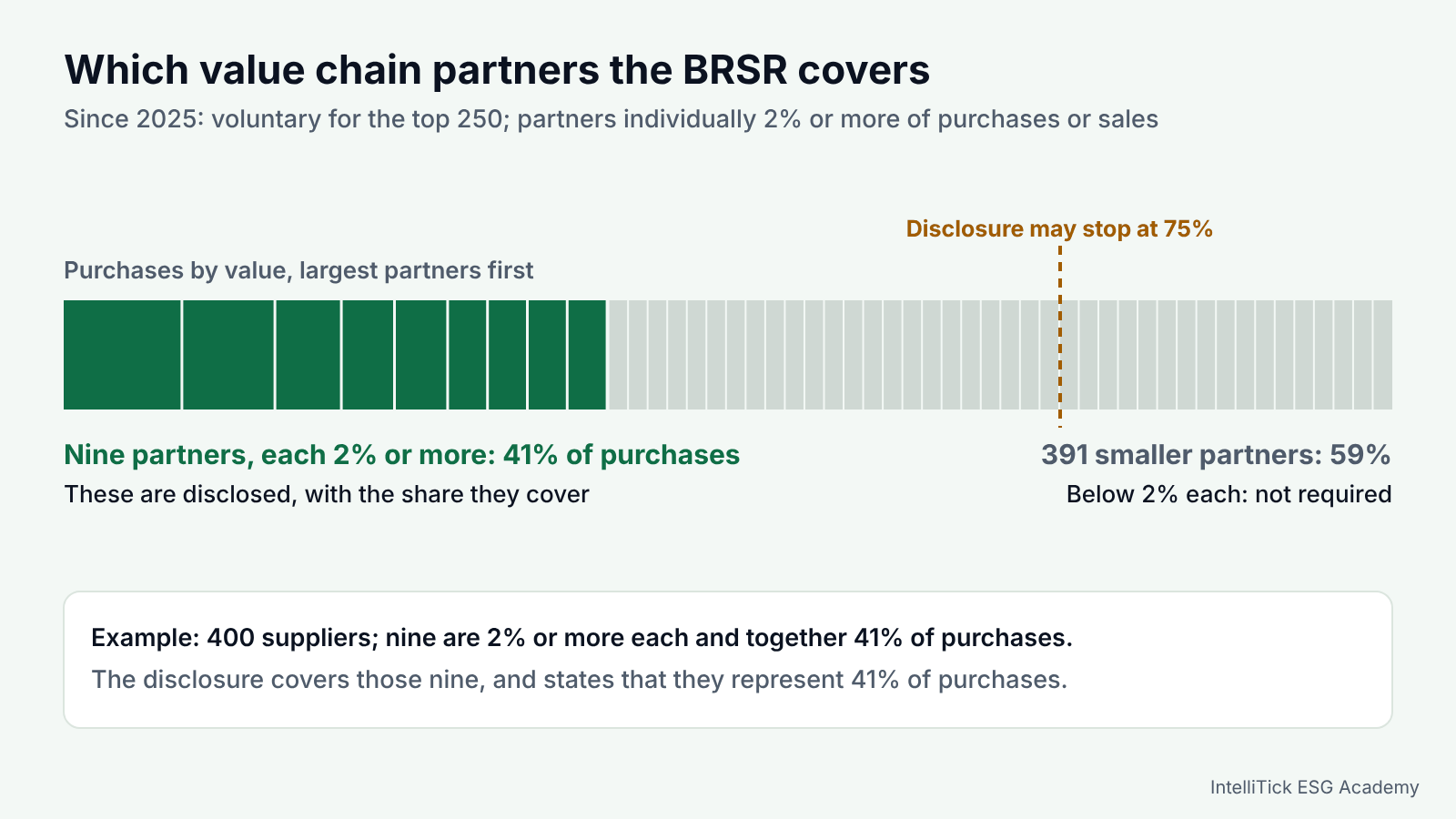
- Who is a value chain partner: an upstream or downstream partner that is individually 2% or more of the company's purchases or sales, by value.
- How far to go: the company may limit its disclosure to partners that together make up 75% of purchases and of sales, and states the percentage covered.
- Who and when: voluntary for the top 250 from FY 2025-26; assessment or assurance of it voluntary from FY 2026-27.
- What: the BRSR Core indicators, for the partners, reported separately from the company's own.
Running a supplier data request
Most suppliers have never prepared BRSR-style figures. Requests that get answers:
- Ask only for what you will report — the BRSR Core indicators — with the definitions and units, and an example.
- Give them a template with drop-downs for units and space for evidence.
- Allow estimates, labelled as such, in the first year; ask for measured data next year.
- Explain the boundary — the supplier's operations that serve you, or the whole supplier — and be consistent.
- Agree a timeline that leaves you time to review before your own year-end close.
The greenhouse gas accounting course explains how supplier data also feeds Scope 3.
Green credits
The same revision added a voluntary leadership indicator under Principle 6: green credits generated or procured by the company and by its top ten value chain partners5. Green credits come from the Government of India's Green Credit Programme. Report what was generated or procured, by whom, and for what activity.
Practice
Which suppliers are in?
A company's purchases total ₹2,000 crore. Its largest suppliers by spend: A ₹260 crore, B ₹190 crore, C ₹150 crore, D ₹120 crore, E ₹70 crore, F ₹45 crore, G ₹38 crore, H ₹30 crore. All others are below ₹30 crore each.
- Which suppliers are value chain partners?
- What percentage of purchases do they cover?
- Must the company add more suppliers to reach 75%?
Show the model answer
- 2% of ₹2,000 crore is ₹40 crore. Partners at or above it: A, B, C, D, E and F (F is ₹45 crore). G (₹38 crore) and H are below 2%.
- 260 + 190 + 150 + 120 + 70 + 45 = ₹835 crore = 41.75% of purchases.
- No. The 75% rule allows the company to stop once its disclosed partners reach 75%; it does not require it to add partners below the 2% threshold. It discloses that the partners cover 41.75% of purchases.
Check your understanding
Choose an answer to see if you are right.
Sources for this lesson
- Master Circular for compliance with the SEBI (LODR) Regulations, 2015 — Chapter IV-B and Annexures 16, 17 and 17A — SEBI (copy published by NSDL). 30 January 2026; checked November 2026
- SEBI circular on assessment or assurance, value chain disclosures and green credits (SEBI/HO/CFD/CFD-PoD-1/P/CIR/2025/42) — SEBI. 28 March 2025; checked November 2026
Completing every lesson opens the exam and the certificate. Sign in with your e-mail to record your progress — no password and no account.
More: BRSR practice questions · notes (PDF) · ESG glossary